The Same Thing Every Day: Fewer Decisions Make Weight Loss Easier
Eat the same meals daily for weight loss that lasts. Say goodbye to decision fatigue. The surprisingly simple eating strategy that actually sticks.
There's an unspoken rule that almost everyone believes in: your diet has to be varied, colorful, different every day. Breakfast unlike yesterday's. Lunch — a surprise. Dinner — a creative challenge. And somewhere around that "creative challenge," your energy runs out by Wednesday, and your meal plan runs out by Friday.
The truth is, there is no such rule. You can eat the same thing every day. And for many people who maintain a calorie deficit and want to lose weight without constant slip-ups, this turns out to be not boredom, but freedom.
Why Monotony Is a Strategy, Not Laziness
The idea is almost embarrassingly simple: instead of deciding what to cook from scratch every day, you assemble one working day of eating — and repeat it. The same breakfast, the same lunch, the same snack, at roughly the same time.
It sounds like surrendering to the kitchen. In reality, it's the opposite. It's an engineering approach to food: think through a system that works once, and then stop spending mental energy on it every day. Those who've tried it describe the effect almost identically — the background noise around food disappears. No standing in front of the fridge, sorting through options, googling recipes, weighing "isn't that too many calories?" The decision has already been made. Once and for all.
And this is where it gets really interesting — not about cooking, but about the brain.
Decision Fatigue: The Quiet Saboteur of Any Diet
Willpower has an unpleasant property — it runs out. Every decision throughout the day depletes it bit by bit: what to wear, how to reply to an email, which route to take, what to eat. Psychologists call this "decision fatigue." By evening the reservoir is empty — and that's exactly why the most sincere plans collapse not at lunch, but at 9 p.m., when your hand reaches for the cookies on its own.
Food is one of the main consumers of this resource. Over the course of a day, a person makes dozens of small decisions about what, when, and how much to eat, and most of them run on autopilot. Every "what could I snack on" is a micro-decision, and each one chips away at self-control just a little.
A monotonous diet eliminates almost all of these decisions at once. Nothing to choose means nothing to tire you out. The freed-up willpower can be spent on what genuinely requires effort: work, a workout, saying no to that very evening cookie. You can read more about the principles of a balanced yet simple diet in the WHO recommendations on healthy eating — there's not a single word there about the menu having to change every day.
How Eating the Same Food Helps You Hold the Deficit
A calorie deficit is math. And math loves constants, not variables.
When a person eats the same thing, they know their numbers exactly. Not approximately, but precisely: this breakfast is 350 kcal, this lunch is 450, the snack is 180. You can add them up in your head in a second, instead of recalculating the calories and macros of every new dish from scratch. After a week, the scale and the mirror give clear feedback: the 1,600 kcal diet is working, or you need to cut another hundred.
With a constantly changing menu, that's not possible. Every new recipe is a new margin of error in the counting. "A spoonful of oil by eye," "well, about half a cup of rice," "the sauce doesn't count" — and just like that, what seemed an honest deficit has turned into maintenance, and the weight isn't budging. Monotony reduces this margin of error to almost zero. The portions are measured out once, the plate looks the same, there's nowhere to slip up.
A bonus — shopping and cooking. The week's grocery list becomes a copy of last week's. Meal prep stops being a heroic feat: the same containers, the same set, no "oops, forgot to buy that." Less wasted food, less money down the drain, fewer spontaneous delivery orders at the moment when "there's nothing to eat at home."
What to Build "That One" Repeating Day From
The main rule for a single day that won't get old or do harm: it should have enough protein, vegetables, and fiber — and something tasty, without fail, that makes you want to come back to this day. Below is an example of a balanced template for a day of roughly 1,500–1,600 kcal. It's a reference point, not a prescription: the numbers are adjusted to your height, weight, activity, and goal.
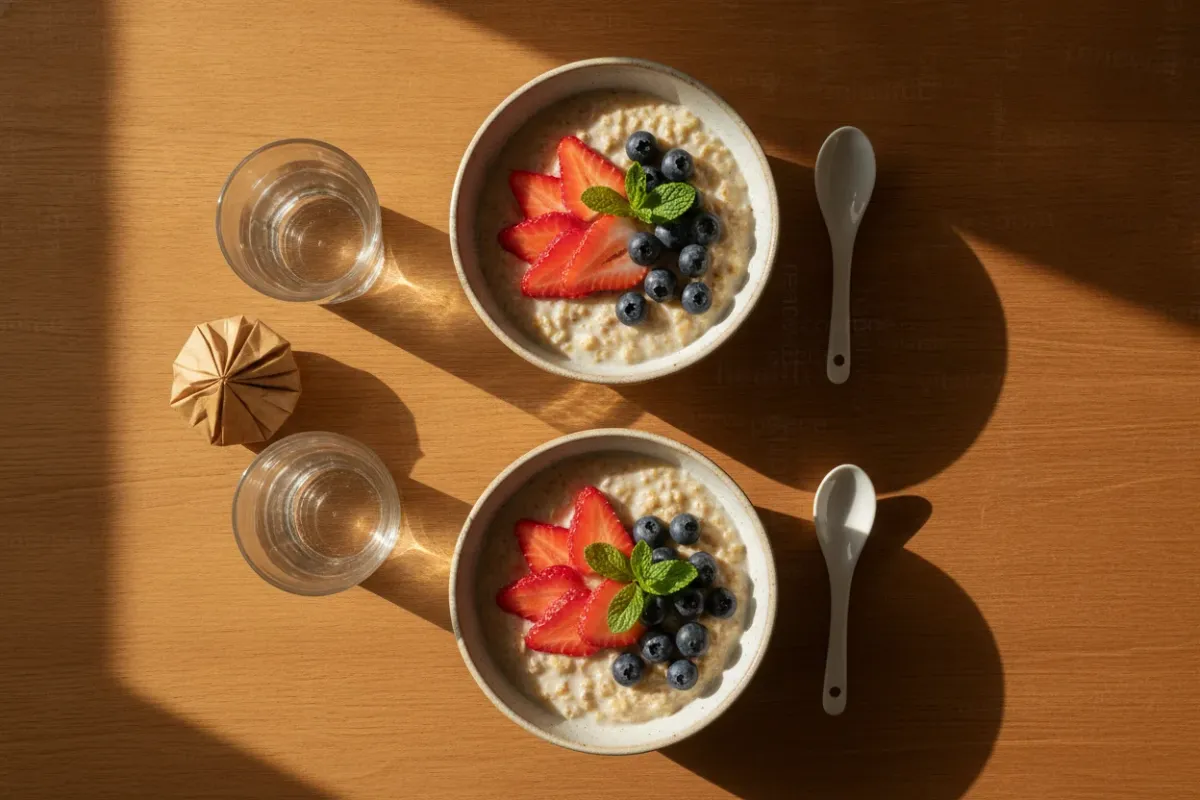
Breakfast: Oatmeal with Protein and Berries
Slow carbs plus protein, so you won't be hungry again within the hour. 50 g of oats, a scoop of protein, a handful of frozen berries, a teaspoon of peanut butter.
Calories & macros: ~350 kcal · P 25 g · F 9 g · C 42 g
Lunch: Chicken, Rice, and Vegetables
A classic that's a classic for good reason. 150 g of chicken breast, 50 g of rice (dry weight), a large portion of vegetables — broccoli, bell pepper, zucchini.
Calories & macros: ~450 kcal · P 42 g · F 8 g · C 50 g
Snack: A Fitness Dessert
The very reason monotony doesn't turn into punishment. A cottage-cheese protein cheesecake or a baked chocolate fondant made with protein — a dessert that satisfies the craving for sweets while adding protein rather than empty calories.
Calories & macros: ~180 kcal · P 20 g · F 6 g · C 12 g
This is exactly where a monotonous diet beats "willpower." When something sweet is built into the plan as a regular meal, it stops being forbidden fruit. There's no need to heroically refuse — you just have to wait for your snack.
Dinner: Fish and Vegetables
A light but filling end to the day. 150 g of white fish or salmon, a salad of fresh vegetables with a spoonful of olive oil.
Calories & macros: ~350 kcal · P 35 g · F 15 g · C 8 g
Day total: ~1,330 kcal · P 122 g · F 38 g · C 112 g — with room to spare for tea, coffee with milk, and a couple of pieces of fruit that bring the daily total up to a comfortable 1,500–1,600 kcal.
The high protein here is no accident: it's the most filling of all and helps preserve muscle on a deficit. The basic principles of how to build a plate from protein, vegetables, and whole foods are clearly laid out in The Nutrition Source from the Harvard School of Public Health — and they map perfectly onto the "one day, repeated many times" format.
More for Men, Less for Women: How to Tailor It to Yourself
The same template doesn't mean the same portions for everyone. A larger, more active man needs noticeably more calories than a woman — and that's normal. The approach isn't about everyone eating 150 g of chicken, but about each person finding their own repeatable day to match their own needs.
The easiest way to adjust your diet is by scaling, not by swapping dishes:
- Need more calories — increase the carbohydrate sides and protein portions: 70 g of oats instead of 50, 200 g of chicken instead of 150, add a second snack.
- Need less — trim the sides and fats, but keep the protein and vegetables almost at full volume to maintain fullness.
The same template, the same logic, just different multipliers. The structure of the day doesn't change — which means decision fatigue doesn't come back either.
Where to Add Safeguards So Things Don't Get Lopsided
Monotony has one honest risk: if the day of eating is poorly assembled, its shortcomings also repeat every day. So it's worth building in a couple of safeguards — without fanaticism, calmly.
- Variety of vegetables and fiber sources. Let the foundation of the day stay constant, but you can rotate vegetables by season: broccoli for cauliflower, bell pepper for green beans. This covers different vitamins and minerals without breaking the system.
- Color on the plate. The more colorful the vegetables and berries are over the course of a week, the broader the range of micronutrients. It's the simplest way to avoid running into a deficiency of something important.
- Seasonal rebuild. One template doesn't have to live forever. Every few weeks, or with a change of season, you can rewrite the day entirely — a summer version with berries and greens, a winter one with stewed vegetables and heartier sides.
- Listen to your body, not the rule. If a particular food makes you feel heavy, bored, or clearly "can't stomach it" — swap it out. The goal of the approach is to remove unnecessary stress, not add new stress in the form of force-fed identical meals.
Monotony works exactly as long as it's a joy, or at least neutral. The moment it turns into coercion, it's no longer freedom from decisions, but just another willpower diet that will end the same way all the previous ones did.
Try It Yourself: A One-Week Experiment
The most honest way to figure out whether this regimen suits you is not to argue, but to test it. For one week, you assemble a single working day of eating: breakfast, lunch, a dessert snack, dinner — with clear calorie and macro numbers. And you live those seven days by one script.
What people usually notice as early as the third or fourth day: the eternal question "what should I eat" disappears, shopping takes ten minutes, the numbers in the food diary add up on their own, and the unplanned pull toward sweets is gone — because it's already in the plan anyway. The freed-up energy is enough for the things that used to get pushed off "until later."
And if after a week it turns out that this way is simpler, calmer, and tastier, then there really is no rule about daily variety. There's only what works for this particular person. And "the same thing every day" is a perfectly workable, honest, and — strangely enough — very pleasant option.
This article is for informational purposes only and is not medical advice. Consult a doctor or dietitian before making dietary changes.