1,200-Calorie Deficit: Meal Prep for the Entire Week
Learn 1,200-calorie meal prep strategies for lasting weight loss. One day of cooking feeds you all week. Stay satisfied without daily stress.
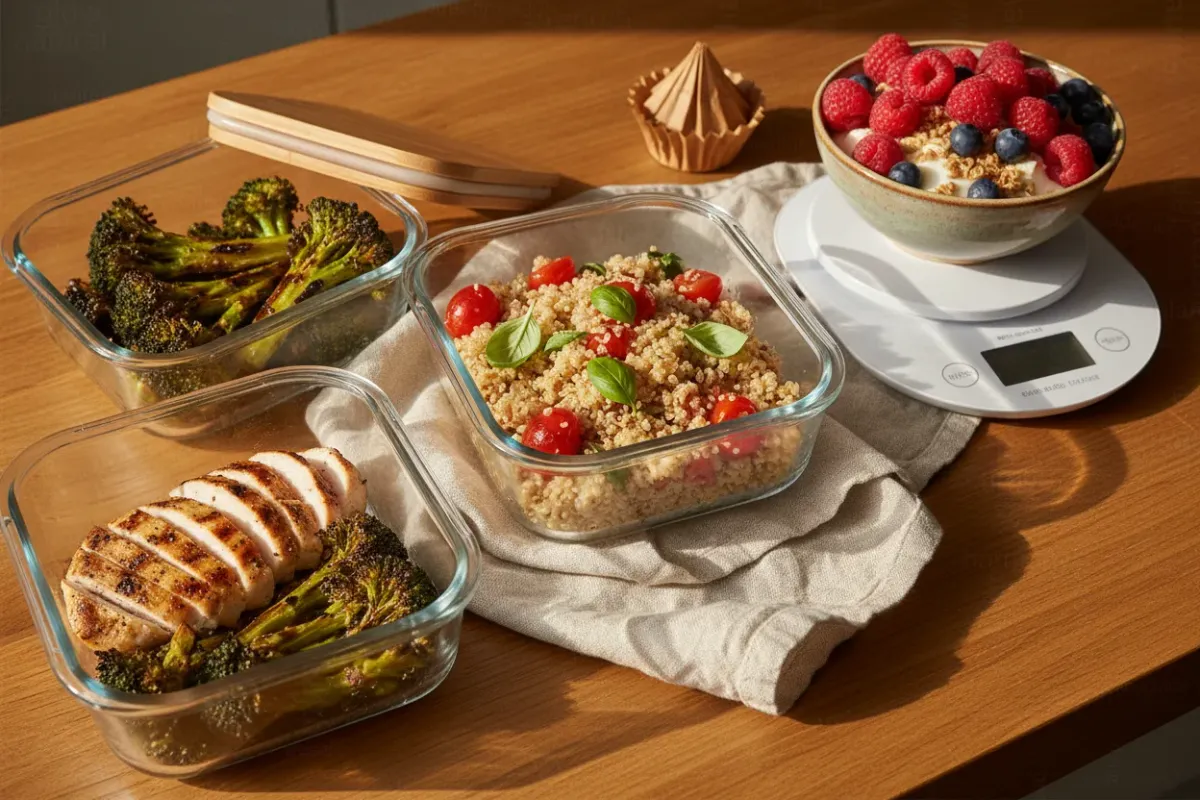
Weight loss is not about starving yourself or giving up delicious food. It's about a well-structured diet where every meal works toward your goal. A 1,200-calorie meal plan with food prepped for the entire week ahead is one of the most convenient ways to maintain a calorie deficit without daily kitchen hassles. One day of cooking — and your fridge is full of containers with food that fits perfectly within your target.
But before you pull out the food scale and containers, it's worth understanding: who is this calorie level right for, how to keep the deficit from becoming a stress on your body, and which foods will make the diet satisfying rather than miserable.
Who Is a 1,200-Calorie Diet Right For
The number 1,200 is not universal. As registered dietitian Julia Zumpano notes in a Cleveland Clinic article, "some people can eat 1,200 calories, lose weight, and still get enough nutrients for a healthy lifestyle. But not everyone." The U.S. National Library of Medicine recommends that women aim for 1,500 calories per day for weight loss, and men — for 2,000 calories.
A 1,200-calorie diet may be appropriate if:
- Your Basal Metabolic Rate (BMR) allows creating a 500-calorie deficit without dropping below a safe minimum
- Your height, weight, and activity level are on the lower side (for example, a woman 5'1"–5'5" with a sedentary job)
- You have no health contraindications
According to Healthline, the standard recommendation for weight loss is reducing caloric intake by 500–750 calories from your daily maintenance level. If your maintenance level is 1,700–1,800 calories, then 1,200 is a perfectly workable deficit. But if your maintenance level is 2,500, dropping straight to 1,200 is too aggressive.
Important Warnings
As Set For Set points out, a 1,200-calorie diet is not suitable for pregnant or breastfeeding women, teenagers under 18, people with a history of eating disorders, or those taking medications that affect appetite or blood sugar levels.
According to Eat This Not That, chronic calorie restriction at this level can lead to fatigue, nutrient deficiencies, hair loss, hormonal imbalances, and decreased bone density. The main risk is not the calorie level itself, but its mindless long-term application without professional supervision.
The golden rule: if you experience persistent weakness, irritability, or hunger that doesn't go away — you need to increase your calories. The recommendation from Set For Set is to move to 1,300–1,600 calories or consult a specialist.
Three Pillars of a Satisfying 1,200-Calorie Diet
When calories are limited, each one must work hard. No "empty" foods — only those that provide satiety, energy, and nutrients.
Protein — The Foundation of Every Meal
Protein stays in the stomach the longest, provides a feeling of fullness, and protects muscle mass during a deficit. As Set For Set recommends, you should "prioritize protein and fiber at every meal to stay full and preserve muscle mass on a diet."
Target: 1.5–2 g of protein per kilogram of goal weight. For a woman with a goal weight of 60 kg (132 lbs) — that's 90–120 g of protein per day. At 1,200 calories, this means about 30–40% of calories should come from protein.
Best sources for meal prep:
- Chicken breast (per 100 g: 165 kcal / 31 g P / 3.6 g F / 0 g C)
- Turkey (per 100 g: 130 kcal / 29 g P / 1 g F / 0 g C)
- Eggs (per 1 egg: 72 kcal / 6 g P / 5 g F / 0.4 g C)
- Low-fat cottage cheese 2% (per 100 g: 103 kcal / 18 g P / 2 g F / 3 g C)
- Greek yogurt 2% (per 100 g: 60 kcal / 10 g P / 2 g F / 3 g C)
- White fish — cod, pollock (per 100 g: 80 kcal / 17 g P / 0.7 g F / 0 g C)
Fiber — Volume Without Calories
Vegetables and greens take up a lot of space in the stomach, create a feeling of fullness, and contain minimal calories. They're a true lifesaver for those who want to eat large portions while on a deficit.
Leaders in volume with minimal calories:
- Cucumbers (per 100 g: 15 kcal / 0.7 g P / 0.1 g F / 2.8 g C)
- Zucchini (per 100 g: 17 kcal / 1.2 g P / 0.3 g F / 3.1 g C)
- Broccoli (per 100 g: 34 kcal / 2.8 g P / 0.4 g F / 7 g C)
- Green beans (per 100 g: 31 kcal / 1.8 g P / 0.1 g F / 7 g C)
- Spinach (per 100 g: 23 kcal / 2.9 g P / 0.4 g F / 3.6 g C)
- Cauliflower (per 100 g: 25 kcal / 1.9 g P / 0.3 g F / 5 g C)
Target: at least 25 g of fiber per day. That's roughly 400–500 g of vegetables plus a serving of grains or legumes.
Healthy Fats — Not the Enemy, but a Necessity
Even on a deficit, fats are needed for hormones, vitamin absorption, and normal brain function. The minimum is 0.8 g per kilogram of body weight. For 60 kg (132 lbs) — that's 48 g of fat, or about 430 calories.
Compact sources:
- Olive oil (1 tsp = 45 kcal / 5 g F)
- Avocado 1/4 (about 80 kcal / 7 g F)
- Almonds 10 pieces (about 70 kcal / 6 g F)
- Flaxseed 1 tbsp (55 kcal / 4 g F)
1,200-Calorie Meal Prep Plan: Step-by-Step Guide
Meal prep isn't just "cooking a bunch of food." It's a system where one day of preparation ensures a calm and delicious week. Here's a specific plan.
Step 1: Creating a Weekly Menu
According to Good Housekeeping, the 1,200-calorie plan is "designed to be supplemented and adapted" — increasing vegetable portions and adding fruits as snacks. If the food isn't enough, you can add 30–150 g of protein to any meal.
Breakdown by meals:
- Breakfast: 250–300 kcal
- Lunch: 350–400 kcal
- Dinner: 350–400 kcal
- Snack: 100–150 kcal
Total: ~1,150–1,250 kcal — with a small buffer for sauces, beverages, and scale margin of error.
Step 2: Weekly Grocery List
Here's a specific list for one person for 7 days:
Protein:
- Chicken breast — 1.2 kg
- Eggs — 14
- Low-fat cottage cheese 2% — 800 g
- Greek yogurt — 500 g
- Pollock or cod fillet — 500 g
Vegetables and greens:
- Broccoli — 500 g
- Zucchini — 700 g
- Green beans — 400 g
- Cucumbers — 500 g
- Tomatoes — 400 g
- Spinach — 200 g
- Onion, garlic, fresh herbs — to taste
Grains and carbs:
- Buckwheat — 400 g (dry)
- Brown rice — 300 g (dry)
- Oatmeal — 300 g
Fats and extras:
- Olive oil — 100 ml
- Almonds — 100 g
- Flaxseed — 50 g
Fruits (for snacks):
- Apples — 4
- Berries (frozen) — 300 g
Approximate budget: 2,500–3,500 rubles depending on region and season.
Step 3: Cooking Day — Sunday
The entire process takes 2.5–3 hours. Here's the order of operations:
First hour — grains and protein:
- Start cooking buckwheat (400 g dry → ~1,000 g cooked)
- Start cooking brown rice (300 g dry → ~750 g cooked)
- Cut chicken breast (1.2 kg) into portions, bake at 180°C (350°F) with minimal oil, spices, and lemon juice — 25–30 minutes
- Hard-boil 10 eggs
Second hour — vegetables:
- Break broccoli into florets, blanch for 3 minutes
- Slice zucchini into rounds, roast at 200°C (400°F) — 20 minutes
- Blanch green beans for 4 minutes
- Bake pollock/cod with lemon and herbs — 15 minutes at 190°C (375°F)
Third hour — assembly:
- Distribute everything into containers (you'll need 14–16)
- Each container = one meal
- Weigh, record macros, stick a label with the date
Fresh vegetables (cucumbers, tomatoes, herbs) — don't prep in advance, cut them right before eating.
Sample 3-Day Menu with Macros
Day 1 (~1,210 kcal / 108 g P / 42 g F / 102 g C)
Breakfast (290 kcal): Oatmeal cooked in water 50 g (dry) + 1 egg + 80 g berries
- Macros: 290 kcal / 14 g P / 8 g F / 40 g C
Lunch (390 kcal): Chicken breast 150 g + buckwheat 80 g (cooked) + roasted zucchini 150 g + 1 tsp olive oil
- Macros: 390 kcal / 40 g P / 12 g F / 30 g C
Dinner (380 kcal): Baked pollock 150 g + brown rice 80 g (cooked) + broccoli 150 g + 1 tsp olive oil
- Macros: 380 kcal / 32 g P / 12 g F / 28 g C
Snack (150 kcal): Low-fat cottage cheese 2% — 150 g + half an apple
- Macros: 150 kcal / 22 g P / 10 g F / 4 g C
Day 2 (~1,195 kcal / 112 g P / 38 g F / 98 g C)
Breakfast (280 kcal): Omelet from 2 eggs + spinach 50 g + tomato 80 g
- Macros: 280 kcal / 16 g P / 12 g F / 28 g C
Lunch (380 kcal): Chicken breast 150 g + brown rice 80 g (cooked) + green beans 150 g + 1 tsp olive oil
- Macros: 380 kcal / 40 g P / 10 g F / 28 g C
Dinner (385 kcal): Low-fat cottage cheese 2% — 200 g + buckwheat 80 g (cooked) + roasted zucchini 150 g
- Macros: 385 kcal / 40 g P / 8 g F / 34 g C
Snack (150 kcal): Greek yogurt 150 g + 5 almonds + berries 50 g
- Macros: 150 kcal / 16 g P / 8 g F / 8 g C
Day 3 (~1,205 kcal / 105 g P / 40 g F / 105 g C)
Breakfast (300 kcal): Oatmeal cooked in water 50 g (dry) + 1 tbsp flaxseed + apple
- Macros: 300 kcal / 8 g P / 8 g F / 50 g C
Lunch (385 kcal): Baked pollock 150 g + buckwheat 80 g (cooked) + broccoli 150 g + green beans 100 g + 1 tsp olive oil
- Macros: 385 kcal / 35 g P / 12 g F / 30 g C
Dinner (370 kcal): Chicken breast 150 g + roasted zucchini 200 g + brown rice 80 g (cooked)
- Macros: 370 kcal / 40 g P / 8 g F / 25 g C
Snack (150 kcal): 2 hard-boiled eggs + cucumber
- Macros: 150 kcal / 22 g P / 12 g F / 0 g C
The remaining 4 days can be built using the same logic, combining protein bases, grains, and vegetables in different combinations. The key is to stay within the 1,150–1,250 kcal corridor and keep protein above 100 g.
How Not to Fall Off Track: Practical Tips
Variety Through Sauces and Spices
The same chicken breast can taste completely different every day:
- Monday: paprika + garlic + lemon
- Tuesday: soy sauce + ginger + sesame (1 tsp of sauce = 3 kcal)
- Wednesday: Italian herbs + tomato paste (1 tbsp = 15 kcal)
- Thursday: curry + turmeric + coconut milk (1 tbsp = 30 kcal)
Spices add virtually no calories but completely transform the flavor of a dish.
The "Warm + Crunchy + Fresh" Rule
Each container should have at least three textures: warm protein, crunchy vegetables, and something fresh (cucumber, herbs, a slice of lemon). This makes the food more interesting and creates the sensation of a complete dish rather than "diet slop."
Portion Volume Matters
At 1,200 kcal, it's easy to assemble a visually large plate if you focus on vegetables. A portion of 150 g chicken, 80 g buckwheat, and 200 g vegetables is a full plate that looks quite satisfying. But if you replace the vegetables with, say, 100 g of pasta — the portion visually shrinks by half at the same calorie count.
Containers and Storage
- Use containers with dividers — grains won't get soggy from vegetables
- Chicken and fish preps keep in the refrigerator for 3–4 days; after that, it's better to freeze them
- Grains keep for up to 5 days
- Label containers: day of the week + meal + calorie count
Common Mistakes on a 1,200-Calorie Diet
Mistake 1: Ignoring Fats
Trying to squeeze into 1,200 kcal, many people completely eliminate oil, nuts, and egg yolks. The result — dry skin, brittle nails, constant hunger. A minimum of 35–45 g of fat per day is mandatory, even on a deficit.
Mistake 2: Eating the Same Food Every Day
Monotony is the number one reason for diet breaks. Even within the same set of base products, you can create different combinations. Rotating grains (buckwheat, rice, bulgur), vegetables, and cooking methods (roasting, stewing, blanching) saves you from boredom.
Mistake 3: Skipping Snacks
It seems logical: "I'll save 150 kcal on a snack and spend more on dinner." In practice, this leads to overeating in the evening. Evenly distributing calories throughout the day maintains stable blood sugar levels and reduces the likelihood of breaking the diet.
Mistake 4: Staying in a Deficit Too Long
As Eat This Not That notes, "the biggest risk is when people drop below 1,200 calories or maintain this level long-term without supervision." The optimal approach is cycles of 4–8 weeks followed by a transition to maintenance calories. This protects your metabolism from adaptive slowdown.
How to Adapt the Plan to Your Needs
According to WebMD, to determine your maintenance level, you need to multiply your current weight in pounds by 15 (or use the Mifflin-St Jeor formula for a more precise calculation in metric). A 500-calorie deficit from that number is the standard recommendation for losing about 0.5 kg (1 lb) per week.
If your calculated deficit brings you below 1,200 — it's better to stop at 1,200 and add physical activity to increase expenditure. Don't treat 1,200 as a dogma — it's the lower limit, not the goal.
Per the recommendation of Stefani Sassos, registered dietitian at Good Housekeeping, "1,200 calories may be an appropriate amount for some people's health goals, but for many it's restrictive." If after the first week you feel a lack of energy — increase the plan to 1,400–1,500 kcal and adjust portions accordingly.
Frequently Asked Questions
How to Avoid Feeling Hungry on 1,200 kcal?
The key is portion volume and composition. Focus on protein (at least 100 g per day), fiber from vegetables (400+ g), and adequate water intake (1.5–2 liters). As Set For Set recommends, prioritizing protein and fiber at every meal is the main satiety strategy on a deficit.
Do I Need to Eat Exactly 1,200 kcal Every Day?
No, a variance of 50–100 kcal in either direction is acceptable. Your body responds to the average calorie intake over the week, not the exact number each day. If one day you hit 1,150 and another day 1,280 — that's fine, as long as the weekly average stays within the plan.
How Much Protein and Fiber Do I Need on a 1,200-Calorie Diet?
Protein: at least 90–120 g per day (1.5–2 g per kg of goal weight). Fiber: at least 25 g per day. That's approximately 400–500 g of vegetables plus a serving of grains or legumes daily. This combination ensures satiety and muscle mass preservation.
How to Efficiently Prep Food for the Week?
Set aside 2.5–3 hours on a weekend day. First, start cooking grains and eggs, simultaneously bake your protein, then process the vegetables. Distribute into containers with dividers, label with the day and calorie count. Store the first 3–4 days in the refrigerator, the rest — in the freezer.
Can I Stay on 1,200 kcal for a Long Time?
Most specialists recommend cycles of 4–8 weeks with a break at maintenance calories. Prolonged restriction can slow metabolism and lead to nutrient deficiencies. According to Cleveland Clinic, before starting any low-calorie diet, it's best to consult with a dietitian.
This article is for informational purposes only and is not medical advice. Consult a doctor or dietitian before making dietary changes.