Korean Dishes for a Calorie Deficit: Ssamchu-ssam and Bibimbap
Discover delicious Korean dishes like ssamchu-ssam and bibimbap perfect for weight loss. Learn how to eat hearty meals while maintaining a calorie deficit.
Korean Cuisine for a Calorie Deficit: Hearty, Tasty, and Full of Vegetables
Healthy eating and calorie control aren't necessarily about bland chicken breast and buckwheat. It can be an exciting culinary journey, for example, to the East. Korean cuisine, with its philosophy of balance, abundance of fermented products and vegetables, offers many ideas for hearty and low-calorie dishes. As noted in a source about healthy Korean food, its benefits are largely built on a wide variety of protein dishes and the use of low-calorie seasonings like soy sauce, which add flavor without extra calories Fitsian Food Life.
In this article, we will take a deep dive into two classic Korean dishes that perfectly fit into a calorie-deficit diet: ssamchu-ssam and bibimbap. These are not just recipes, but a whole approach to food, where the main roles are given to vegetables, protein, and smart flavor combinations. We will analyze their benefits, cooking principles, and, of course, calculate their macros to inspire you to try healthy and delicious experiments in the kitchen.
Why are Korean dishes ideal for calorie control?
Before moving on to specific recipes, it's worth understanding the philosophy that makes Korean food so friendly to fitness goals. It's not about restrictions, but about smart balance.
1. Vegetable culture. A Korean meal is unthinkable without banchan — many small side dishes. Among them, there are always pickled, fermented (like the famous kimchi), and fresh vegetables. This provides a lot of volume with minimal calories. As suggested by participants in a Reddit discussion, low-calorie Korean foods include kimchi, pickled radish, various root vegetables, and grilled vegetables Reddit r/KoreanFood. This approach satiates well and provides fiber.
2. Emphasis on protein. Many main dishes are built around fish, seafood, tofu, beef, or chicken. Protein is a key macronutrient for satiety and preserving muscle mass during a calorie deficit. Cooking often involves grilling, stewing, or boiling, which doesn't require a lot of oil.
3. Fermented foods. Kimchi, jang (pastes) — these are not just probiotics for gut health, but also a powerful flavor accent. The spicy, sour, savory note allows you to use a minimum of salt and fat, making the dish bright without compromising the macros.
4. The "ssam" (쌈) principle. This is when ingredients are wrapped in a lettuce leaf or other greens. It literally means "wrapping" and is a genius way to increase portion size with greens, get a crunchy texture, and control the amount of sauce or rice. This principle is the basis of one of today's featured dishes.
Now, with an understanding of this foundation, let's move on to specific dishes that healthy eating enthusiasts highlight as favorites.
Ssamchu-ssam (쌈추쌈): Healthy Wraps with Fillings
What is it? Ssamchu-ssam is not a specific dish with a rigid recipe, but rather a style of eating and serving. A plate with fresh, crunchy lettuce leaves (most often green or red leaf lettuce, sometimes kale or perilla leaves) is brought to the table, along with various fillings: boiled or grilled meat (pork, beef, chicken), fish, tofu, rice, ssamjang sauce, and other banchan. Everyone at the table assembles their own "roll": puts whatever they want inside a leaf, wraps it up, and eats it.
Why is it a great choice for a calorie deficit?
- Volumetric satiety. As noted by the author in the original discussion, ssamchu-ssam is a dish that is "super rich in vegetables and filling" Reddit r/1200isplenty. Lettuce leaves create a large physical volume of food, which quickly fills the stomach and signals satiety with a relatively low calorie content of the greens themselves. Especially if, as advised, you "stuff a whole lettuce leaf" with filling.
- Full control over portions and macros. You decide how much rice, protein, and sauce to add. This teaches mindfulness. Want more protein? Go ahead. Want to reduce carbs? Add less rice or skip it altogether, increasing the share of vegetables.
- Macronutrient balance. In one such wrap, you get fiber from the greens, protein from the filling, and complex carbohydrates from a small portion of rice (if added). This is a balanced meal.
How to assemble the perfect ssamchu-ssam for a fitness menu?
The process is more like a creative act than cooking. Here's a step-by-step plan.
Ingredients (for 1 serving):
- Base (leaves): 5-7 large green lettuce leaves (romaine, iceberg, corn salad) — ~15 kcal.
- Protein (choose one option):
- 120 g boiled or baked chicken breast — ~140 kcal, 26 g protein.
- 100 g grilled tofu — ~120 kcal, 12 g protein.
- 100 g boiled shrimp — ~85 kcal, 18 g protein.
- 80 g lean grilled beef (e.g., for bulgogi) — ~150 kcal, 22 g protein.
- Carbs (optional): 50 g cooked brown or white rice — ~65 kcal.
- Vegetables and additions:
- Cucumber, julienned — 30 g (~5 kcal).
- Carrot, julienned (can be blanched) — 30 g (~10 kcal).
- Sweet pepper strips — 30 g (~8 kcal).
- Kimchi — 30 g (~10 kcal).
- Sauce: 1 tsp light ssamjang or a variation (you can mix 0.5 tsp doenjang paste, 0.5 tsp sesame oil, garlic, a bit of erythritol) — ~25 kcal.
Process:
- Cook the chosen protein: boil, bake in the oven, or fry in a non-stick pan without oil. Marinate in soy sauce with garlic and ginger if desired.
- Thinly slice all vegetables.
- Arrange washed and dried lettuce leaves on a plate.
- Separately arrange the fillings on a plate or in small bowls: sliced protein, rice, vegetables, sauce.
- Assembly: take a lettuce leaf in your hand, put a little rice inside (if using), then pieces of protein, vegetables, a bit of kimchi, and a drop of sauce. Gently wrap it into a pocket or roll and eat.
Macro calculation per serving (example with chicken and rice):
- Calories: ~398 kcal
- Protein: ~30 g
- Fat: ~6 g
- Carbs: ~45 g
Such a meal is perfect for lunch or dinner. It's bright, requires interaction with food, which slows down the eating process and promotes better satiety.
Bibimbap (비빔밥): A Balanced Bowl with Vegetables
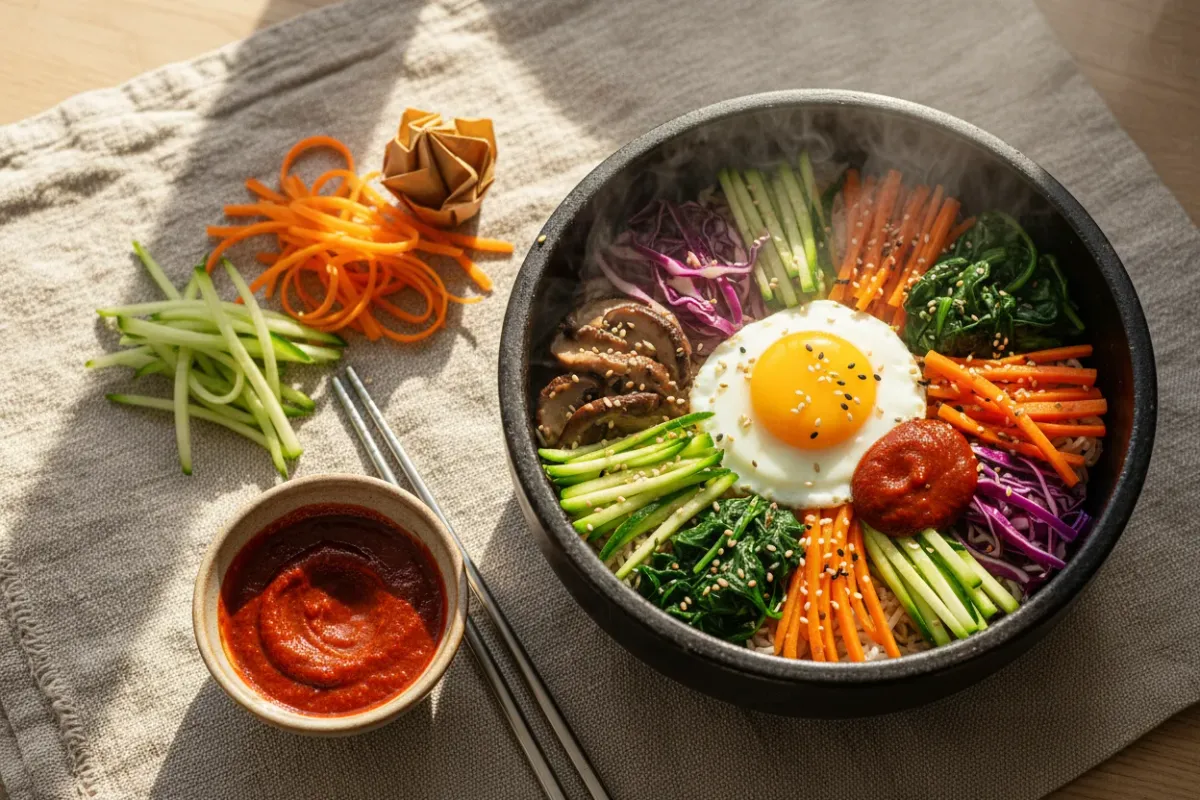
What is it? "Bibim" means "to mix," "bap" — "rice." Bibimbap is a large bowl of warm rice, on which various sautéed, pickled, and fresh vegetables, protein (meat, tofu, egg), and gochujang paste are neatly arranged in sections. Before eating, everything is thoroughly mixed, turning into an incredibly aromatic, colorful, and hearty dish.
Why is it a great choice for a calorie deficit?
- Perfect balance "by default." Like ssamchu-ssam, bibimbap is a dish that, according to healthy eating enthusiasts, is "super rich in vegetables and filling" Reddit r/1200isplenty. It is originally conceived as a harmonious combination of all food groups. You get complex carbs (rice), fiber and vitamins (5-7 types of vegetables), quality protein, and healthy fats (often from sesame oil).
- Versatility and meal prep potential. Vegetables for bibimbap can be prepared in advance for 2-3 days. The same goes for protein. In the morning, you only need to cook fresh rice (or reheat pre-prepared rice) and assemble the bowl. This makes bibimbap an ideal candidate for weekly meal planning.
- Intense flavor without extra calories. Vegetables for bibimbap are often lightly fried or sautéed with a minimal amount of oil, soy sauce, and sesame. Gochujang paste, even in small amounts, gives a rich spicy and slightly sweet flavor. This allows you to avoid high-calorie creamy or mayonnaise-based sauces.
How to make light bibimbap at home?
The secret is in preparing each component separately. It may seem labor-intensive, but many steps can be done in parallel.
Ingredients (for 1 serving):
- Base: 80-100 g cooked brown rice — ~105-130 kcal.
- Vegetables (choose 4-5 types, each cooked separately):
- Spinach (sigeumchi): 50 g. Blanch, squeeze, mix with 0.5 tsp sesame oil and a pinch of salt. ~25 kcal.
- Carrot (danggun): 50 g. Cut into matchsticks, quickly sauté in a non-stick pan with a drop of oil. ~20 kcal.
- Zucchini (hobak): 50 g. Cut into half-moons, sauté like carrots. ~10 kcal.
- Mushrooms (beoseot): 50 g shiitake or button mushrooms. Slice, sauté with soy sauce (1/2 tsp). ~15 kcal.
- Bean sprouts (kongnamul): 50 g. Boil for 2-3 minutes, season with sesame oil and salt. ~20 kcal.
- Kimchi: 30 g. Chop. ~10 kcal.
- Protein (choose one):
- 1 poached or fried egg in a non-stick pan — ~80 kcal.
- 70 g ground beef, fried in "bulgogi" style (with soy sauce, garlic, ginger, and half a tsp of honey or erythritol) — ~120 kcal.
- 100 g tofu, cubed and fried until crispy — ~120 kcal.
- Sauce: 1 tsp gochujang paste (or a mixture: 0.5 tsp gochujang, 0.5 tsp water, 0.5 tsp apple cider vinegar, a bit of erythritol) — ~15 kcal.
- Additionally: 0.5 tsp sesame seeds for sprinkling — ~15 kcal.
Process:
- Cook the rice.
- While the rice is cooking, prepare all vegetables: slice and sauté/boil each type in a separate pan or in the same one, but washing it in between. The key is not to mix flavors and colors until assembly.
- Cook the chosen protein.
- Assembly: place warm rice in a deep bowl. On top, neatly arrange the cooked vegetables and protein in sections. Place the egg (if using) or the gochujang paste in the center. Sprinkle with sesame seeds.
- Serve immediately, thoroughly mixing the contents before eating.
Macro calculation per serving (example with egg and brown rice):
- Calories: ~410 kcal
- Protein: ~18 g
- Fat: ~14 g
- Carbs: ~55 g
Other Ideas for a Low-Calorie Korean Menu
Ssamchu-ssam and bibimbap are just the tip of the iceberg. Korean cuisine is full of other finds for those watching their calories.
- Soup Doenjang-jjigae (된장찌개). As advised in one discussion, many Korean soups are low-calorie. Doenjang-jjigae — fermented soybean paste doenjang — gives the soup a deep umami flavor. If you make it with tofu, zucchini, onions, mushrooms, and seafood or a minimal amount of lean meat, you get a very hearty and warm dish for 200-300 kcal per large serving Facebook Korean Food.
- Hoe (회) — sashimi. Various types of fresh raw fish (sea bass, salmon, tuna) are pure protein and healthy fats. Served with lettuce leaves, chojang sauce (based on gochujang), and other fresh vegetables following the ssam principle.
- Jeon (전) — pancakes. Not all jeon are low-calorie, but vegetable versions like yachaejeon (vegetable pancakes with flour) can be made lighter by using whole wheat flour and frying in a good non-stick pan with minimal oil. As shown in recipe collections, such dishes often fall into the "450 calories per meal" category Pinterest.
- Grill. A Korean barbecue table isn't just about fatty brisket. Lean beef tenderloin, chicken breast, shrimp, mushrooms, and vegetables on the grill are a great option for a high-protein, low-carb dinner.
How to Integrate Korean Dishes into Your Meal Plan?
For these ideas to bring not only gastronomic joy but also help achieve goals, follow simple tips:
- Control the rice. This is the main source of calories in bibimbap and a possible component in ssamchu-ssam. Use measuring cups. Try mixing white rice with brown rice or cauliflower rice to increase volume.
- Cook protein correctly. Choose grilling, baking, boiling, or steaming. For marinades, use low-sodium soy sauce, pear or apple juice, ginger, and garlic instead of large amounts of sugar or honey.
- Don't be afraid of vegetables. The more types and colors of vegetables you add, the more vitamins and fiber you get. Frozen vegetable mixes can save time.
- Be careful with sauces. Ssamjang, gochujang, and sesame oil are very tasty but calorie-dense. Measure them with teaspoons, don't pour "by eye." You can dilute them with water or vinegar.
- Practice meal prep. Prepare a large batch of sautéed carrots, spinach, mushrooms, and protein on Sunday. During the week, you'll only need to cook fresh rice or wash lettuce leaves to assemble lunch in 10 minutes.
Try It Yourself: Start Small
Korean cuisine may seem exotic, but its principles — abundance of vegetables, balance of flavors, and interactivity — are universal and work perfectly for healthy eating.
You don't have to prepare a full set of banchan right away. Start small:
- Next time you grill chicken, serve it not with a side dish, but with large lettuce leaves, sliced cucumber, and a spoonful of light sauce. You'll get your first ssamchu-ssam.
- For dinner, assemble a "bibimbap bowl" from leftovers: yesterday's rice, an omelet cut into strips, fresh cucumber, store-bought Korean-style carrots, and a drop of hot sauce. Mix and enjoy.
The main thing is a mindful approach and enjoyment of the process. As the example with "ssamjang cream udon" shows, even more calorie-dense dishes can be balanced by adding, for example, a portion of grilled chicken bulgogi, which adds only about 160 calories but a lot of protein Fitsian Food Life. Healthy eating is about flexibility, variety, and the ability to find delicious solutions that work specifically for you. May your journey to your goals be as bright and rich as a bowl of bibimbap.
This article is for informational purposes only and is not medical advice. Consult a doctor or dietitian before making dietary changes.