Sunday Ingredient Prep: How 2 Hours of Prep Day Save Your Entire Week
Ingredient prep in 2 hours transforms your week. Prep components Sunday, assemble different meals in minutes daily. Say goodbye to meal prep boredom.
What is an ingredient prep day and why it's not regular meal prep
There's a big difference between cooking five containers of identical chicken breast and rice — and prepping ingredients that you can assemble into different meals in minutes throughout the week. The first approach is classic meal prep. The second is ingredient prep, or component preparation. And it's the second approach that works for those who get tired of eating the same thing five days in a row.
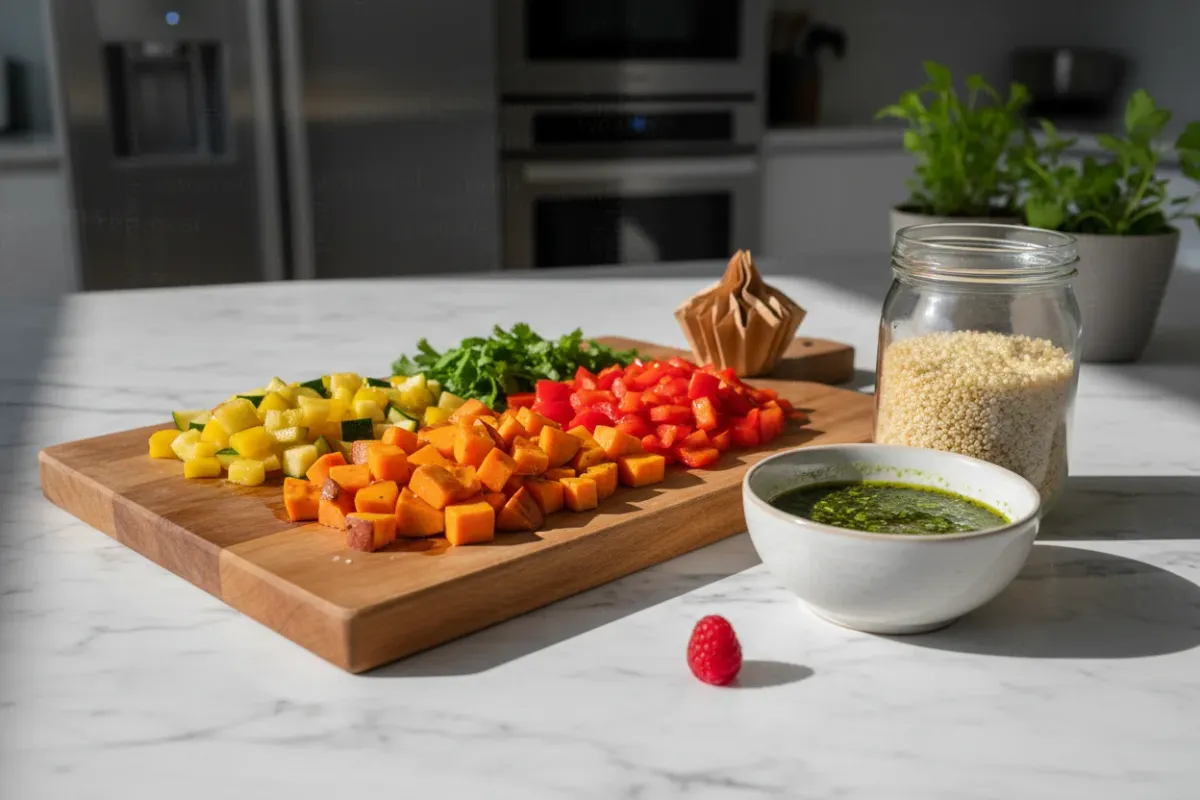
The idea is simple: on Sunday, you don't need to cook complete meals. It's enough to wash, chop, roast, and portion out basic ingredients — proteins, grains, vegetables, sauces. Then on weekdays, you assemble completely different dishes from these "building blocks": today a bowl with quinoa and roasted vegetables, tomorrow a soup, the day after — pasta or a tortilla wrap.
As experts from the Harvard T.H. Chan School of Public Health note, prepping food for the week saves time and money when you prepare exactly as much as you need for the coming days. And a study published in PMC (National Library of Medicine) confirms: people who cook at home consume fewer calories, spend less money on food, and gain less weight compared to those who regularly eat out or buy ready-made meals.
Why Sunday specifically — and how long it takes
Sunday isn't a magic date — it's simply a convenient point before the work week begins. Some people prep on Saturday, others on Wednesday, splitting the week into two mini-cycles. The key is to set aside a fixed slot in your schedule.
According to Nomadette, vegetable prep takes no more than 1–2 hours per week, while saving up to 30 minutes of daily cooking time on weekdays. If you add cooking grains and preparing proteins, you can fit everything into 2–2.5 hours.
A typical Sunday schedule looks like this:
- Saturday — grocery shopping (with a ready-made list based on your plan)
- Sunday, 2–2.5 hours — washing, chopping, roasting, boiling, portioning
- Monday–Friday — assembling meals in 10–15 minutes
This exact rhythm is also described in the Reddit community MealPrepSunday: shopping on Saturday, prepping on Sunday. Participants honestly discuss whether it's worth spending a day off cooking — and most conclude that ingredient prep (as opposed to full cooking) takes significantly less time and doesn't create the feeling of a "wasted weekend."
Step-by-step plan for Sunday prep day
Step 1. Create a meal plan and shopping list (15 minutes, Friday–Saturday)
You don't need to plan a menu down to the gram. It's enough to sketch out five lunches and five dinners for the week and identify the base components:
- Protein: chicken, turkey, fish, eggs, tofu, legumes
- Complex carbs: rice, quinoa, bulgur, buckwheat, pasta, sweet potato
- Vegetables for roasting: broccoli, zucchini, bell pepper, onion, carrot
- Vegetables for fresh salads: cucumbers, tomatoes, greens (prepped separately)
- Sauces and dressings: pesto, tkemali, lemon-olive dressing, hummus
The key principle: prep universal components that can be combined in different ways, not finished dishes.
Step 2. Start the oven and stovetop simultaneously (first 30 minutes)
This is the key hack — running processes in parallel. While the oven heats up to 220°C (425°F), put the grains and eggs on the stovetop.
On the stovetop:
- Rice or quinoa — 15–20 minutes
- Buckwheat or bulgur — 15 minutes
- Hard-boiled eggs — 10 minutes
- Legumes (if not canned) — varies by type
In the oven: As experts at WorkWeekLunch recommend, vegetables for roasting should be divided into groups by cooking time:
- Quick (20 minutes): broccoli, zucchini, cauliflower
- Slow (30 minutes): sweet potato, carrot, onion, squash
Each group should go on a separate baking sheet, drizzled with 1 tablespoon of oil per serving, and different vegetables shouldn't be mixed — this makes it easier to distribute them into containers later. Flipping during cooking isn't necessary, although for a more even crust you can flip them halfway through.
Step 3. Chopping and prepping raw vegetables (20 minutes)
While the grains are cooking and the vegetables are roasting — it's the perfect time to chop fresh ingredients. This follows the mise en place principle — everything washed, chopped, and organized.
According to recommendations from Yummy Toddler Food, hard vegetables (carrots, broccoli, cauliflower) keep in the fridge for up to 5 days when pre-cut. However, soft and moist vegetables — bell peppers, mushrooms — are best planned for the first days of the week.
What to chop in advance:
- Carrots — sticks and rounds
- Cucumbers — for salads (store in a container with a paper towel)
- Celery — sticks for snacking
- Onion — half-rings (for quick sautéing on weekdays)
- Garlic — finely minced and stored in oil
What's better not to chop in advance: Potatoes, sweet potatoes, mushrooms, and avocado darken quickly — they're best cut right before cooking, as experts at Yummy Toddler Food note.
Tip for storing greens: According to Nomadette, leafy greens (spinach, lettuce) keep for 4–5 days if placed in a container lined with a paper towel — it absorbs excess moisture and prevents the leaves from getting soggy.
Step 4. Preparing proteins (30–40 minutes)
Protein is the foundation of a satisfying healthy eating plan. Here are options for Sunday prep:
Chicken breast or thigh: Roast whole with a minimal set of seasonings (salt, pepper, paprika, garlic). Don't slice it — a whole piece stores longer and doesn't dry out. Slice or shred it at the time of meal assembly.
Ground meat (turkey or beef): Sauté with onion and basic spices. Store without sauce — this way it can be used in pasta, a bowl, a tortilla wrap, or soup.
Eggs: Hard-boil 6–8 eggs. Store in their shells.
Legumes: Soak chickpeas or beans overnight on Saturday, boil on Sunday. Or use canned — there's no shame in that and it's significantly faster.
According to the Harvard Nutrition Source, cooked meat, fish, and poultry should be used within 3–4 days. So protein prepped on Sunday needs to be used by Wednesday or Thursday. If you need protein for Thursday–Friday — freeze a portion.
Step 5. Sauces and dressings (15 minutes)
Sauce is what transforms the same set of ingredients into completely different dishes. Three basic sauces for the week solve the "same food" problem:
Lemon-olive dressing (for salads and bowls): Olive oil + lemon juice + salt + garlic. Per 100 ml: ~450 kcal, P: 0, F: 50, C: 2.
Tomato sauce (for pasta and stewed dishes): Canned tomatoes in their own juice + garlic + basil + olive oil. Per 100 ml: ~45 kcal, P: 1, F: 2, C: 5.
Yogurt sauce (for bowls and meat): Greek yogurt + cucumber + dill + garlic + salt. Per 100 ml: ~55 kcal, P: 5, F: 2, C: 4.
Step 6. Portioning and storage (15 minutes)
Each component goes into separate containers:
- Grains — in one set
- Roasted vegetables — in another
- Proteins — separately
- Fresh vegetables — separately, with a paper towel on the bottom
Don't mix components into one container — that defeats the whole purpose of ingredient prep. Separate containers give you the freedom to combine.
How to assemble meals from your preps: weekly examples
Here's how the same set of prepped ingredients turns into different dishes:
Monday — quinoa bowl
Quinoa + roasted broccoli and zucchini + chicken breast + yogurt sauce + fresh cucumber. Macros per serving (350 g): ~380 kcal, P: 32, F: 12, C: 35.
Tuesday — pasta with ground meat
Pasta (cook fresh in 10 minutes) + sautéed ground meat + tomato sauce + roasted onion. Macros per serving (400 g): ~450 kcal, P: 28, F: 14, C: 52.
Wednesday — egg and vegetable salad
Mixed greens + boiled eggs + fresh cucumbers and carrot sticks + roasted sweet potato + lemon dressing. Macros per serving (300 g): ~320 kcal, P: 16, F: 18, C: 24.
Thursday — soup from preps
Broth (chicken or vegetable, bouillon cubes work too) + leftover roasted vegetables + legumes + chopped onion and garlic — 20 minutes on the stove. According to the Harvard Nutrition Source, soups and stewed dishes can be frozen and stored for 2–3 months at 0°F (–18°C) or below. Macros per serving (350 ml): ~220 kcal, P: 14, F: 6, C: 28.
Friday — tortilla roll
Whole wheat tortilla + leftover ground meat or chicken + fresh vegetables + yogurt sauce. Macros per serving (250 g): ~360 kcal, P: 24, F: 12, C: 38.
Notice: from one Sunday prep set, you got five different lunches. None repeats another, yet the assembly time for each is 10–15 minutes.
What to prep for healthy snacks
Prep day is a great time to prepare snacks as well. According to Everyday Health, chopping and prepping fruits and vegetables reduces food waste: if produce is already washed and cut, the chances of it being eaten rather than forgotten in the back of the fridge are significantly higher.
Veggie sticks + hummus: Carrots, celery, cucumber — cut into sticks, divide into individual bags. Hummus — in small containers. Macros (serving of 150 g vegetables + 50 g hummus): ~160 kcal, P: 6, F: 8, C: 16.
Protein balls (energy balls): Oats + peanut butter + honey + protein powder + cocoa. Roll into balls, refrigerate. They keep for up to 5 days. Macros (1 ball, ~30 g): ~110 kcal, P: 5, F: 5, C: 12.
Berries: A tip from Nomadette: to make berries last longer, soak them in a solution of equal parts vinegar and water for 10 minutes, then dry them thoroughly before storing. This removes mold spores from the surface.
Boiled eggs: The simplest protein snack — 2 eggs, already ready in the fridge. Macros (2 eggs): ~140 kcal, P: 12, F: 10, C: 1.
Storage rules: what lasts how long
Without proper storage, the entire prep day loses its purpose. Here are the key timeframes:
| Product | Refrigerator shelf life | Freezer |
|---|---|---|
| Cooked meat, poultry, fish | 3–4 days | up to 3 months |
| Cooked grains | 4–5 days | up to 3 months |
| Roasted vegetables | 4–5 days | up to 2 months |
| Chopped hard vegetables (raw) | up to 5 days | — |
| Soft vegetables (peppers, mushrooms) | 2–3 days | — |
| Leafy greens | 4–5 days | — |
| Soups and stews | 3–4 days | 2–3 months |
| Sauces | 5–7 days | — |
Key rules:
- All containers must be airtight
- A paper towel at the bottom of vegetable containers absorbs condensation and extends freshness
- Root vegetables (potatoes, beets) with remaining soil are best wiped with a slightly damp paper towel but not washed — as experts at WorkWeekLunch advise, excess dirt accelerates spoilage
- Vegetables for roasting should be thoroughly dried after washing — oil and water don't mix, and wet vegetables won't brown properly
Ingredient prep and macro tracking
One of the main advantages of component prep is calorie transparency. When each ingredient is stored separately, it's easy to weigh the right portion and know exactly how many calories are on your plate.
This is especially relevant for those who count calories or track macronutrient balance. Instead of trying to break down a complex finished dish into components in a tracking app, you simply add up the macros of individual ingredients.
Sample lunch calculation from preps:
| Component | Weight | Kcal | P | F | C |
|---|---|---|---|---|---|
| Cooked quinoa | 150 g | 180 | 7 | 3 | 30 |
| Chicken breast | 120 g | 140 | 29 | 2 | 0 |
| Roasted broccoli | 100 g | 55 | 4 | 2 | 6 |
| Yogurt sauce | 30 g | 17 | 2 | 1 | 1 |
| Total | 400 g | 392 | 42 | 8 | 37 |
A precise, balanced lunch assembled in 5 minutes. This is exactly how ingredient prep helps you reach your nutrition goals without constant stress.
According to Everyday Health, meal prepping helps eliminate impulsive food decisions. When the fridge is full of prepared ingredients, you're less tempted to order delivery or reach for a bag of chips — because assembling a complete meal is faster than waiting for a courier.
Ingredient prep for fitness desserts
Prep day is the ideal time to prepare the base for healthy desserts for the week:
Baking bases:
- Grind oats into flour (stores in a jar for up to 2 weeks)
- Chop nuts for toppings
- Make date paste (dates + water, blend until smooth)
Preps for quick desserts:
- Chia pudding: pour plant milk over chia seeds in individual jars. By morning — a ready-made breakfast or dessert. Macros (200 g): ~180 kcal, P: 6, F: 8, C: 20
- Frozen bananas: peel, slice into rounds, arrange on parchment paper and freeze — the base for single-ingredient "ice cream"
- Nut butter: roast nuts, blend until creamy
These preps let you make a healthy dessert in 5–10 minutes on weekdays instead of 40.
Common mistakes and how to avoid them
Prepping too much. Food goes bad — and instead of saving, you end up with a thrown-out container on Thursday. It's better to start with 3–4 days and add a mini-prep on Wednesday if needed.
Mixing everything into one container. A salad doused in dressing on Sunday turns into mush by Wednesday. Sauces and dressings — always separate.
Prepping things that don't store well. As experts at WorkWeekLunch note, soft vegetables like tomatoes and mushrooms can get mushy if prepped in advance for dishes that are then stored in the fridge. Fruits are also better left uncut unless necessary.
Not labeling containers. After three days, it's hard to remember which is Tuesday's ground meat and which is Wednesday's. Labels with the preparation date solve the problem.
Prepping without a plan. Prepping "lots of everything" is a path to food waste. First the meal plan, then the shopping list, then the prep.
Frequently asked questions
How should prepped ingredients be stored?
Each component goes in a separate airtight container. Place a paper towel at the bottom of containers with vegetables and greens to absorb moisture. Label the preparation date. Soft vegetables and products with shorter shelf life should go toward the front of the shelf so they're used first.
How long does ingredient prep take?
Based on experience and data from Nomadette, a full prep of vegetables, grains, and proteins takes 1.5–2.5 hours. Meanwhile, up to 30 minutes are saved daily on weekdays. By the second or third week, the process becomes automatic and speeds up.
How do you avoid getting tired of the same food?
That's the very advantage of ingredient prep over classic meal prep: you're prepping components, not dishes. From one set of ingredients, you can assemble a bowl, soup, pasta, salad, or roll — a different lunch every day, one prep day.
How do you figure out what exactly to prep?
Start with three questions: which protein do you like most? Which grain is your favorite? Which vegetables do you want to eat every day? The answers give you your base set. As noted by Eat the Gains, you don't have to prep complete meals — even preparing a few components (protein, a side, and chopped vegetables) already significantly simplifies weekdays.
This article is for informational purposes only and is not medical advice. Consult a doctor or dietitian before making dietary changes.