Protein for vegetarians: building muscle without the extra fat
Protein for vegetarians: Stop the skinny-fat cycle. Learn exact protein needs, top plant sources, and meal strategies for real muscle gains.
The "skinny but soft" state — when your weight seems fine, but the mirror shows a lack of density and definition — is familiar to very many people who switch to plant-based eating. The good news: it's entirely realistic for a vegetarian to build muscle without drowning in fat in the process. The bad news: the internet dumps a hundred contradictory pieces of advice on your head, and figuring out where the truth lies is genuinely hard. Below is a calm, no-fanaticism breakdown: how much protein you actually need, which sources work best, and how to put together an ordinary day so that your muscles grow rather than your waistline.
How much protein you really need for muscle
The key number around which everything else is built. A major review and meta-analysis from 2018 in the British Journal of Sports Medicine showed that, for gaining muscle mass during strength training, it makes sense to bring protein up to roughly 1.6 grams per kilogram of body weight per day — beyond that, the effect barely grows (study by Morton et al.).
For a vegetarian, it's reasonable to aim for the upper part of the range — 1.8–2.2 g/kg. The reason lies in protein quality (more on this below): plant sources are absorbed slightly worse and are poorer in the key amino acid leucine, so a small surplus in quantity compensates for the difference.
A simple guideline:
- weight 60 kg → about 110–130 g of protein per day;
- weight 70 kg → about 125–150 g;
- weight 80 kg → about 145–175 g.
The number seems big, but it's quite achievable without forcing yourself, if you know where the "concentrated" protein is.
Leucine — the muscle-growth switch
Of all the amino acids, it's leucine specifically that triggers muscle protein synthesis. To press the "button" properly, it's desirable to get about 2.5–3 g of leucine in a single meal — that's roughly 25–40 g of protein at once. That's why what works is not "eat everything in the evening," but 3–4 meals with protein in each one. Dairy, eggs, and soy are closest to animal sources in leucine, while legumes and grains finish off the quota through volume and combinations. A detailed breakdown of norms for athletes is in the position stand of the International Society of Sports Nutrition (ISSN).
What a "complete" protein is and why it matters
Protein consists of amino acids, nine of which are essential — the body doesn't synthesize them, they come only from food. A "complete" protein contains all nine in sufficient quantity: these are eggs, dairy products, and soy. Most legumes and grains are "incomplete" on their own — legumes are low in methionine, grains are low in lysine.
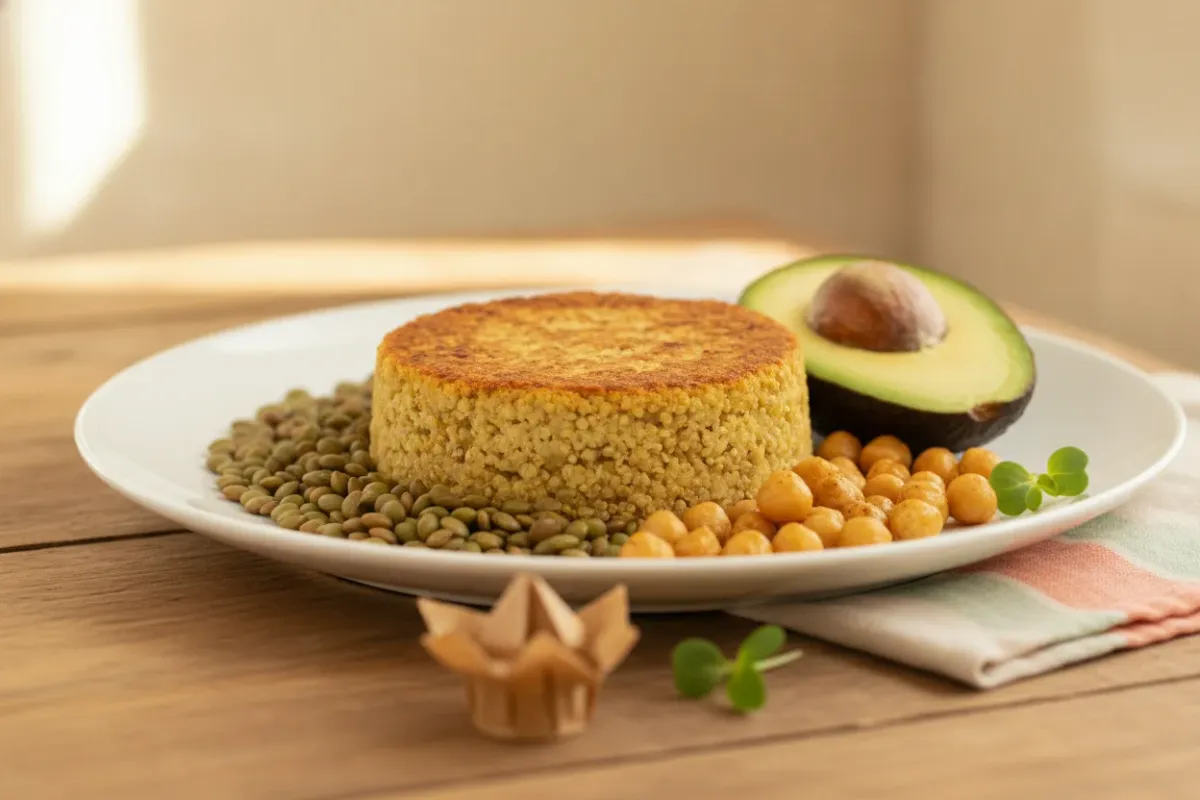
The solution is elegant and tasty: legumes + grains over the course of a day provide a complete amino acid profile. Lentils with rice, hummus with whole-grain bread, beans with buckwheat — classics not because of tradition, but because of biochemistry. And you don't need to get it all in one sitting: enough variety over the day is sufficient.
The best protein sources for a vegetarian
Next is a working "shelf," from the most concentrated to the supplementary ones. Macros are given per 100 g unless stated otherwise.
Dairy products and eggs — the easiest start
Those who eat dairy and eggs (lacto-ovo vegetarians) are lucky: this is complete protein with high leucine and minimal fuss.
- Low-fat cottage cheese — ~71 kcal, protein 18 g, fat 1 g, carbs 1.5 g. The champion in protein-to-calorie ratio. The slow casein protein is great for the evening.
- 5% cottage cheese — ~121 kcal, protein 16 g, fat 5 g, carbs 3 g. Creamier and tastier, with a small difference in calories.
- 2% Greek yogurt — ~73 kcal, protein 9 g, fat 2 g, carbs 4 g. A base for breakfasts, sauces, and protein desserts.
- Eggs — 1 piece (~50 g) ~70 kcal, protein 6 g, fat 5 g, carbs 0.4 g. The gold standard of absorption; the yolk is no enemy — it holds vitamins and choline.
- Hard cheese — ~350–400 kcal, protein 25 g, fat 28 g. Lots of protein, but just as much fat — this is a seasoning, not a main source.
Soy — the best plant protein
Soy is the only widely available plant product with complete protein, which is why it's a dietary mainstay for a vegetarian.
- Tofu — ~76 kcal, protein 8 g, fat 4.8 g, carbs 1.9 g. Neutral taste, soaks up any marinade. Firm tofu contains more protein than silken.
- Tempeh — ~190 kcal, protein 19 g, fat 11 g, carbs 9 g. Fermented soybeans: the record-holder among plant sources for protein density, with a nutty flavor.
- Edamame — ~125 kcal, protein 12 g, fat 5 g, carbs 9 g. Green soybeans; a convenient snack with fiber.
- Soy milk — ~54 kcal, protein 3.3 g per 100 ml. The only plant "milk" with protein on par with cow's milk; rice and almond are nearly empty in this respect.
Legumes — fiber and protein in one
Cheap, filling, with slow carbs. The main nuance is that, along with protein, a fair amount of carbs comes too, which you factor into the day's overall balance.
- Lentils (boiled) — ~116 kcal, protein 9 g, fat 0.4 g, carbs 20 g. Cooks quickly, no soaking required.
- Chickpeas (boiled) — ~164 kcal, protein 9 g, fat 2.6 g, carbs 27 g. The base of hummus; roasted chickpeas make a crunchy snack.
- Beans (boiled) — ~125 kcal, protein 9 g, fat 0.5 g, carbs 22 g.
Pseudocereals and grains — support, not a foundation
- Quinoa (boiled) — ~120 kcal, protein 4.4 g, fat 1.9 g, carbs 21 g. A rare grain with a complete amino acid profile.
- Buckwheat (boiled) — ~110 kcal, protein 4 g, fat 1 g, carbs 20 g. Not much protein, but it perfectly "covers" legume pairs with lysine.
Protein here is modest, but it's grains in combination with legumes that make plant protein complete.
Seitan — for those who tolerate gluten
Seitan (wheat gluten) — ~140–160 kcal, protein up to 25 g, fat 2 g, carbs 4 g per 100 g. In protein density it rivals meat and contains almost no fat. The downside — it's poor in lysine, so it's paired with legumes, and it is absolutely unsuitable in cases of celiac disease.
Nuts and seeds — protein with a caveat
- Hemp seeds — ~550 kcal, protein 31 g, fat 49 g. Complete protein, but the calorie count is set by the fat.
- Pumpkin seeds — ~560 kcal, protein 30 g, fat 49 g.
This is more a source of healthy fats and micronutrients. Relying on them for protein for the sake of mass is expensive in calories — a spoon or two in a salad or yogurt, no more.
Protein supplements — closing the gap
When you can't reach the target from regular food, powder solves the issue quickly and without extra calories.
- Whey protein — a 30 g serving: ~120 kcal, protein 24 g, fat 1–2 g, carbs 2–3 g. High in leucine, ideal after a workout (suitable for lacto-vegetarians).
- Pea/rice protein — a 30 g serving: ~110 kcal, protein 21–24 g. A vegan alternative; a blend of pea and rice gives a balanced amino acid profile.
Supplements are an addition to food, not a replacement for it: whole foods also provide fiber, vitamins, and satiety.
How to build a 120+ g protein day
An example for a person of ~70 kg, with a target of about 1.8 g/kg. No exotics, just ordinary foods:
- Breakfast: an omelet from 3 eggs + 100 g of 5% cottage cheese → ~34 g of protein.
- Snack: 200 g of Greek yogurt + a spoon of seeds → ~22 g of protein.
- Lunch: 150 g of lentils (boiled) + 150 g of buckwheat + vegetables → ~20 g of protein (and a complete amino acid profile thanks to the "legume + grain" pairing).
- Afternoon snack: a serving of protein with soy milk → ~27 g of protein.
- Dinner: 120 g of tempeh, sautéed with vegetables → ~23 g of protein.
That's a total of ~126 g of protein at moderate calories. By swapping tempeh for tofu, lentils for chickpeas, and whey protein for pea protein, the same scheme is easily adapted to a vegan diet or personal tastes.
Skinny-fat: it's not only about protein
The "skinny but soft" state isn't cured by protein alone, but by a trio of three things.
Strength training. Protein is the building material, but the stimulus to grow comes from the load. Without working with weights or your own body, the extra protein simply goes to energy. 3–4 strength sessions a week with progressive overload are the foundation.
Calories near maintenance. With "skinny-fat," an aggressive surplus will flood you with fat, while a heavy deficit will eat into your already modest muscles. The working option is recomposition: keep calories close to maintenance (or a slight deficit of ~10%), but with high protein. The body gradually changes its composition — more muscle, less fat — even if the number on the scale stays almost in place. The quality of protein sources affects overall health — the Harvard School of Public Health writes about this briefly and to the point.
Patience and distribution. Protein at 25–40 g in each of 3–4 meals works better than "everything at dinner." And the visible result of recomposition takes months, not weeks; that's normal.
Try it yourself
You shouldn't start by buying five tubs of powder, but with something small: calculate your weight, multiply by 1.8, and for a couple of days simply observe how much protein adds up from your usual food. Almost always it turns out that you're short by literally one or two meals — and you close them with cottage cheese, tempeh, a bowl of lentils with buckwheat, or a sugar-free protein dessert.
By the way, protein desserts are the most pleasant way to top up the quota: a cottage cheese mousse, a cheesecake on Greek yogurt, a chocolate pudding on tofu easily provide 15–25 g of protein per serving and at the same time feel like a treat rather than "healthy food eaten by force." Healthy eating without fanaticism is exactly about this — when the protein for your muscles comes, among other things, on a plate you actually want to finish.
This article is for informational purposes only and is not medical advice. Consult a doctor or dietitian before making dietary changes.