Thick Bakery-Style Cookies: Healthy Recipe and Secrets
Thick bakery-style cookies can be healthy. Discover the secrets to making soft, gooey cookies with fewer calories—no sacrifice on taste. Learn how!
Why Everyone Is Obsessed with Thick Cookies
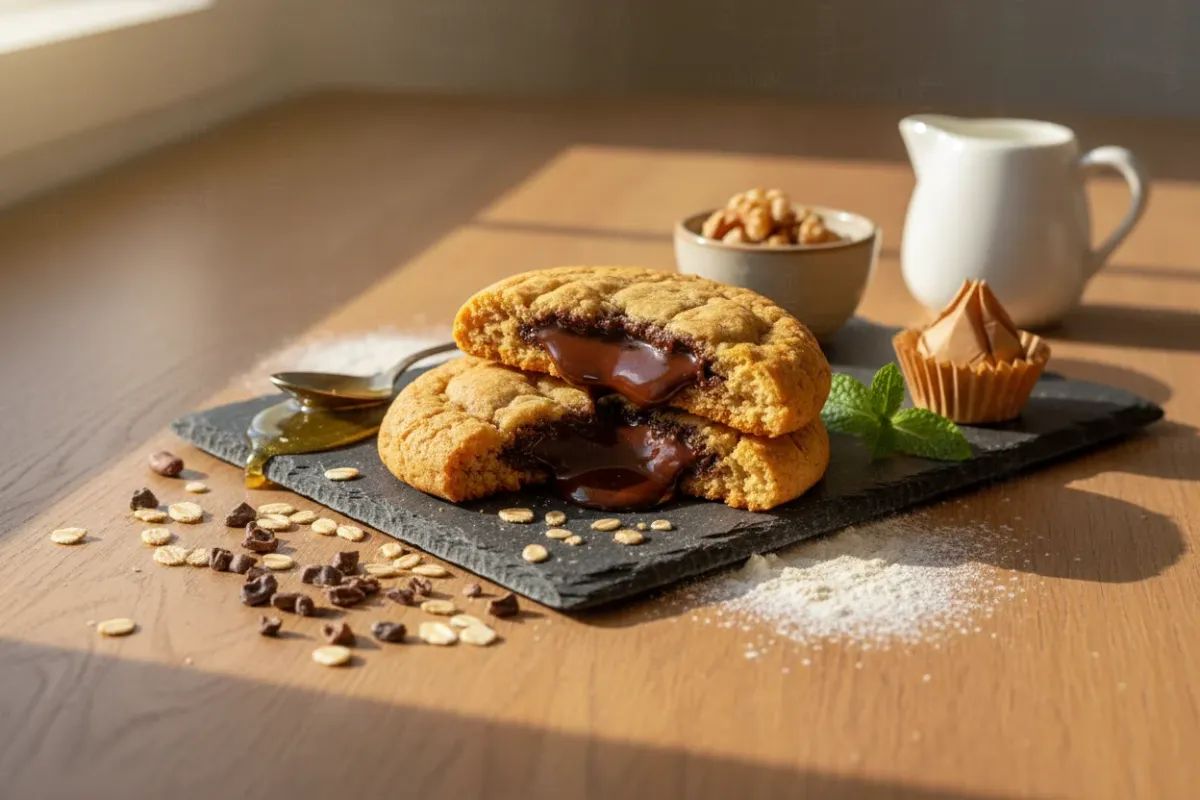
There are two types of people: those who love thin crispy cookies, and those who love thick, soft ones with a gooey center that you want to break in half and watch the melted chocolate stretch inside. Judging by the popularity of Levain Bakery–style recipes and the endless discussions on Reddit, the latter are the overwhelming majority.
As noted on Reddit r/Cookies, most people prefer cookies "with volume in the middle" — precisely for that texture that makes it worth turning on the oven.
But here's the problem: classic thick cookies are butter, sugar, white flour, and chocolate in industrial quantities. A single Levain Bakery–style cookie weighs about 170 grams and easily packs 500–600 calories. For those watching their diet, that sounds like a death sentence.
The good news is that a cookie's thickness and softness depend not so much on the amount of sugar and butter, but on technique. Which means you can achieve that same texture in a healthier version. Let's break down how it works.
The Science of Thickness: Why Some Cookies Are Flat and Others Are Puffy
Before diving into the recipe, it's worth understanding the physics of the process. This will help you not just follow a recipe, but control the outcome.
Dough Thickness Changes Everything
According to The Bake School, many home bakers face the issue of cookies turning out too thick — or, conversely, spreading into a pancake. The reason is that dough thickness is one of the simplest parameters for controlling the result.
As the experts at Fat & Weird Cookie explain, thicker dough yields "less spreading, taller cookies, a soft center, and a longer baking time." Thick dough heats up more slowly, and this completely changes the texture: a slight crunch on the outside, softness and gooeyness on the inside.
Four Factors That Make Cookies Thick
Here's what actually affects height and texture:
1. Dough temperature before baking. This is arguably the main secret. Chilled dough melts more slowly in the oven, which means it spreads less. This is exactly how bakeries achieve those puffy cookies — they use large portions of dough and bake it chilled.
2. Dough portion size. The bigger the dough ball, the thicker the cookie. Bakery-style recipes use portions from 60 to 170 grams — a far cry from the teaspoons in grandma's cookbook.
3. Ball shape. As Sally's Baking Addiction advises, a proven trick for thick cookies is to shape dough balls "taller rather than wider — almost like a cylinder" or "bumpy columns." This works because a tall shape needs more time to settle.
4. Ingredient ratios. More flour relative to fat means less spreading. More sugar and fat means the cookie flattens out. This is a fundamental principle that can be applied to healthy versions as well.
Why Chilling Is Not a Whim
Dough chilling deserves its own discussion because it affects not only shape but also flavor. As Handle the Heat points out, chilling the dough "improves cookies in every way": it creates a thicker, chewier texture and a richer, deeper caramel flavor.
The minimum chilling time is 30 minutes. But according to the Serious Eats Levain Bakery–style recipe, for the best results the dough should chill for at least 12 hours. One Handle the Heat reader left the dough in the fridge for 24 hours — and the result was still excellent.
For busy people, this is actually more convenient: mix the dough in the evening, put it in the fridge, and in the morning — fresh baked goods in 15 minutes.
Temperature and Time: Exact Numbers
Different sources give slightly different temperature recommendations, and this is no coincidence — the optimal setting depends on the cookie size.
| Portion Size | Temperature | Baking Time | Source |
|---|---|---|---|
| ~60 g (medium-large) | 163°C (325°F) | 13–14 minutes | Sally's Baking Addiction |
| ~162 g (Texas-sized) | 190°C (375°F) | 15 minutes | House of Yumm |
| ~170 g (Levain style) | — | ~22 minutes | Serious Eats |
| ~80–100 g (large) | 190°C (375°F) | 13–14 minutes | Sugar Spun Run |
The general principle: the larger the cookie, the longer it bakes. At the same time, the internal temperature of a finished cookie should reach 71–85°C (160–185°F) — at this temperature the eggs are completely safe, while the center stays soft.
An important point: according to Sugar Spun Run, thick cookies are "fragile and prone to breaking while warm" and "will look underbaked in the center" if broken open before fully cooling. This is normal — don't add extra baking time, or the cookies will dry out.
After baking, the cookies should cool on the baking sheet for at least 10 minutes — during this time the center will "finish" from residual heat.
The Healthy Version: Thick Cookies Without Extra Calories
Now for the most interesting part — how to adapt the classic for healthy eating while preserving that signature texture.
Basic Healthy Thick Chocolate Cookies Recipe
Ingredients (makes 8 cookies):
- Oat flour — 150 g (you can grind rolled oats in a blender)
- Almond flour — 50 g
- Coconut oil (softened) — 50 g
- Erythritol or another sugar substitute — 60 g
- Egg — 1
- Protein powder (vanilla or chocolate) — 30 g (1 scoop)
- Dark chocolate 70%+ — 60 g (roughly chopped with a knife)
- Baking powder — 1 tsp
- Pinch of salt
- Vanilla extract — 1 tsp
Macros per 1 cookie (makes 8):
- Calories: ~175 kcal
- Protein: 7 g
- Fat: 10 g
- Carbs: 15 g
Compare with the classic: one bakery-style cookie runs 350–600 kcal. The healthy version is half the calories, while containing significantly more protein and fiber.
Step-by-Step Instructions
Step 1. Mix the coconut oil with erythritol until smooth. Add the egg and vanilla extract, stir to combine.
Step 2. In a separate bowl, combine the oat flour, almond flour, protein powder, baking powder, and salt. Add the dry ingredients to the wet gradually — as Sugar Spun Run advises, if you dump all the flour in at once, the dough will be hard to mix and will turn out drier.
Step 3. Fold in the chopped chocolate.
Step 4. Form 8 balls, each weighing approximately 50–55 grams. Shape them tall, like columns — this is the key to thickness.
Step 5. Place on a parchment-lined baking sheet and refrigerate for at least 30 minutes. Ideally — overnight.
Step 6. Bake at 180°C for 12–14 minutes. The cookies will look slightly underdone in the center — this is normal.
Step 7. Cool on the baking sheet for 10 minutes. Don't touch them before that!
Why These Specific Ingredients
Oat flour instead of wheat flour — more fiber, lower glycemic index, soft texture. It works beautifully in cookies, giving them a pleasant crumbly tenderness.
Almond flour adds fats and protein, making the texture richer. It's what helps achieve that "bakery" feel without extra butter.
Protein powder is not just a protein source but a functional ingredient. It absorbs moisture and helps the dough hold its shape, which is critical for thick cookies. Vanilla or chocolate protein powder also doubles as a flavoring.
Coconut oil instead of butter — it has a higher solidification point, meaning the dough becomes denser when chilled and spreads less during baking. This is exactly the effect needed for thickness.
Dark chocolate instead of milk chocolate — less sugar, more cocoa butter and antioxidants. Hand-chopped chocolate creates those uneven, beautiful chunks that look so striking when you break a cookie open.
Variations for Different Goals
Protein Bomb (for those building muscle)
Increase protein powder to 50 g, add 2 tbsp peanut butter, use 2 eggs.
Macros per cookie (makes 8): ~220 kcal | P: 13 g | F: 12 g | C: 14 g
Keto Version (for those limiting carbs)
Replace oat flour with almond flour (200 g total), add 1 tbsp psyllium husk for binding, use erythritol and sugar-free dark chocolate.
Macros per cookie (makes 8): ~195 kcal | P: 8 g | F: 16 g | C: 4 g (net)
Gluten-Free Version
According to Handle the Heat, good results come from replacing regular flour with Bob's Red Mill oat flour at a 1:1 ratio. Since the healthy recipe already uses oat flour, you just need to make sure it's certified gluten-free (regular rolled oats may contain traces of gluten due to cross-contamination during manufacturing).
Storage and Meal Prep
Thick cookies are an ideal candidate for meal prep. Here's how to organize the process:
Raw dough keeps in the refrigerator for up to 72 hours. You can form the balls, arrange them on a board, and put them in the fridge — baking 2–3 at a time as needed.
Freezing the dough is even more convenient. Freeze the formed balls on a board, then transfer to a bag. You can bake them straight from frozen, adding 2–3 minutes to the baking time. Dough keeps in the freezer for up to 3 months.
Baked cookies, as Sally's Baking Addiction notes, keep in a tightly sealed container at room temperature for up to one week. But according to Serious Eats, thick cookies are "best fresh-baked" or within the first 12 hours. This is exactly why freezing the dough is the best strategy: you can always bake a fresh batch.
Meal prep hack: divide the dough into daily portions. Monday — 2 balls from the freezer into the oven while the kettle boils. In 15 minutes — a fresh healthy snack to go with your tea.
Common Mistakes and How to Avoid Them
The cookies still spread
Most likely the dough wasn't chilled enough. Also check the flour-to-fat ratio — if you're using liquid coconut oil (melted), you need to cool it to room temperature first.
Another reason is a too-hot baking sheet. If you're baking a second batch, the sheet needs to cool completely before placing the next round.
The cookies turn out dry and crumbly
Too much protein powder or flour. Protein powder actively absorbs moisture, so when adding it to a recipe you may need a bit more liquid — for example, an extra tablespoon of milk.
Another common cause is overbaking. The cookies should look underdone when you take them out of the oven. This is important to remember — don't give in to the temptation to leave them "just a couple more minutes."
The cookies are too thick and raw inside
Yes, this happens too. As The Bake School notes, if the dough doesn't spread at all, something is wrong with the recipe or technique. Usually the cause is too much flour. You should weigh ingredients on a kitchen scale rather than measuring with cups.
The Shape Trick for Perfect Roundness
A tip from Handle the Heat: to get perfectly round cookies, immediately after baking, trace around each cookie with a round cutter (slightly larger than the cookie's diameter) using quick circular motions. This evens out the edges and makes the cookies look neat — just like from a professional bakery.
When Thick Cookies Are the Perfect Snack
From a healthy eating perspective, thick healthy cookies are one of the best options for a sweet snack:
- 175 kcal per cookie — fits into virtually any calorie budget
- 7 g of protein — thanks to protein powder and almond flour
- Fiber from oats — keeps you full longer
- Dark chocolate — a source of magnesium and antioxidants
The ideal time for this snack is the second half of the day, when the sweet tooth hits. One cookie with a cup of tea or coffee — and the sugar craving retreats, letting you comfortably make it to dinner without breaking your diet.
Try It Yourself
Thick soft cookies are not the exclusive domain of bakeries, nor are they the enemy of healthy eating. The secret to thickness lies in technique, not in the amount of sugar and butter. Chilling the dough, shaping the balls correctly, precise temperature, and baking time — that's what separates a puffy, gooey cookie from a flat disc.
Mix the dough tonight, put it in the fridge, and tomorrow morning bake a couple for breakfast. Break one open, look at the gooey center with chunks of dark chocolate — and see for yourself that delicious and healthy can coexist.
This article is for informational purposes only and is not medical advice. Consult a doctor or dietitian before making dietary changes.