The Secret to the Perfect Sandwich: The Science of Flavor in Every Layer
Unlock the secret to the perfect sandwich. Master layering techniques and flavor science that prevent soggy bread and turn basic ingredients into magic.
A sandwich is not just two slices of bread with filling. It's a construction where every layer plays its own role: textural, flavor, and protective. You can take the same exact ingredients but assemble them two different ways — and end up with either a soggy mess or a dish you can't put down. The difference is all in the technique. Let's break down what goes into a truly great sandwich — from the standpoint of culinary craftsmanship, nutrient balance, and plain common sense.
Why a Sandwich Is Serious Business
It seems simple enough, right? Bread, filling, bread. But it's precisely in this apparent simplicity that the trap lies. Most homemade sandwiches lose to restaurant ones not because of expensive ingredients, but because of neglecting the basic principles of assembly.
A good sandwich is a balance of three things:
- Texture. As Gold Medal Bakery notes, "a sandwich with the same texture throughout is boring, because you already know what to expect from the next bite." Crunch, softness, creaminess — a single sandwich should have at least two or three contrasts.
- Flavor. The saltiness of meat, the freshness of vegetables, the creaminess of sauce — each component complements the other. If everything is equally salty or equally bland, the sandwich doesn't "sing."
- Structure. The correct order of layers is not aesthetics — it's engineering. It determines whether the sandwich falls apart after the first bite or holds together until the last.
And one more point that's often overlooked: a sandwich is an excellent foundation for a balanced meal. It's easy to combine proteins, fats, carbohydrates, and fiber in the right proportions. Especially if you approach it mindfully.
Bread: The Foundation, Not the Wrapper
Bread accounts for 30–40% of the sandwich experience. And it's not just about taste, but also about its ability to withstand the filling.
Which Bread to Choose
For a healthy sandwich, the best options are:
- Whole grain bread — more fiber (about 3–4 g per slice), releases energy more slowly, keeps you full longer.
- Rye bread — dense structure, pronounced flavor, pairs well with salty fillings.
- Sourdough bread — lower glycemic index, pleasant tanginess that works as an additional flavor accent.
- Gluten-free bread (if needed) — it's important to choose options with minimal starch and added sugar.
White bread isn't the enemy, but it gets soggy faster and provides fewer nutrients. If you want something lighter — try thin lavash, lettuce leaves instead of bread, or protein wraps.
Bread Technique
An interesting technique is described on the blog All The Things I Eat: before assembly, place both slices of bread side by side face down, so their bottom parts touch each other. This makes it easier to match the shape and then neatly fold one half onto the other — the edges will align perfectly.
If the bread is soft and you're afraid of crushing it while slicing, use a sharp serrated bread knife and cut with a sawing motion, without pressing down from above. This preserves the airy structure of the crumb.
Moisture Protection: The Barrier That Changes Everything
The main enemy of any sandwich is moisture. Juicy tomatoes, pickled vegetables, wet sauce — all of these turn bread into mush within minutes. But the solution is simpler than it seems.
According to recommendations from Bon Appétit, a thin layer of mayonnaise or butter on both sides of the bread "adds flavor to every bite and serves as a barrier against wet fillings, preventing sogginess." Fat creates a hydrophobic film — water literally cannot soak through the bread.
For those watching calories, instead of mayonnaise you can use:
- Hummus — about 25 kcal per tablespoon, plus plant protein.
- Avocado — the same fat barrier principle, but with healthy monounsaturated fats.
- Low-fat cream cheese — great texture, mild flavor, about 30 kcal per tablespoon.
- Greek yogurt with mustard — minimal calories, maximum flavor.
Another tip from the same source: if the sandwich includes cheese, place a slice on each side of the bread. Cheese also works as a moisture barrier layer.
Protein: Quality Over Quantity
Here's one of the most common mistakes: stuffing the sandwich with as much meat as possible. It seems like more means heartier and tastier. But, as fairly emphasized in the Bon Appétit guide, "more meat doesn't make a better sandwich — a small amount of quality meat does."
Protein Sources for a Healthy Sandwich
| Product (100 g) | Calories | Protein | Fat | Carbs |
|---|---|---|---|---|
| Chicken breast (boiled) | 165 kcal | 31 g | 3.6 g | 0 g |
| Turkey (fillet, roasted) | 157 kcal | 30 g | 3.2 g | 0 g |
| Tuna (canned in water) | 116 kcal | 26 g | 1 g | 0 g |
| Lightly salted salmon | 200 kcal | 20 g | 13 g | 0 g |
| Tofu | 76 kcal | 8 g | 4.8 g | 1.9 g |
| Boiled eggs (2 pcs.) | 155 kcal | 13 g | 11 g | 1.1 g |
For those who like meat with character, there's a great technique: shred it, then sear it in a hot pan with a drop of oil for 6–8 minutes until the edges become crispy. At the end, add a little braising liquid so the meat becomes "slightly saucy." This technique transforms ordinary chicken or beef into restaurant-level filling.
Plant-Based Alternatives
If the sandwich is meatless — that's no reason to make it empty. Falafel, roasted eggplant with tahini, hummus with roasted peppers, tempeh — all of these provide both protein and rich flavor. The combination of legumes with grain bread provides a complete set of amino acids.
Layer Order: Sandwich Engineering
This is where true mastery begins. The order in which you stack ingredients determines not only convenience but also the flavor of every bite.
The Bon Appétit Rule
According to the detailed guide from Bon Appétit: "Stack meat, cheese, and other dense ingredients closer to the bottom — they serve as an anchor for everything. Delicate ingredients — lettuce, sprouts, fresh herbs — go on top."
The Gold Medal Bakery Order
Gold Medal Bakery suggests a specific sequence:
- Sauce/condiment — on the bread.
- Meat — spread so it fills the bread all the way to the edges.
- Cheese — on top of the meat.
- Clean and dry vegetables — on the cheese.
The logic is simple: heavy ingredients on the bottom create a stable platform, light ones on top don't get crushed and maintain their texture.
General Scheme for a Homemade Healthy Sandwich
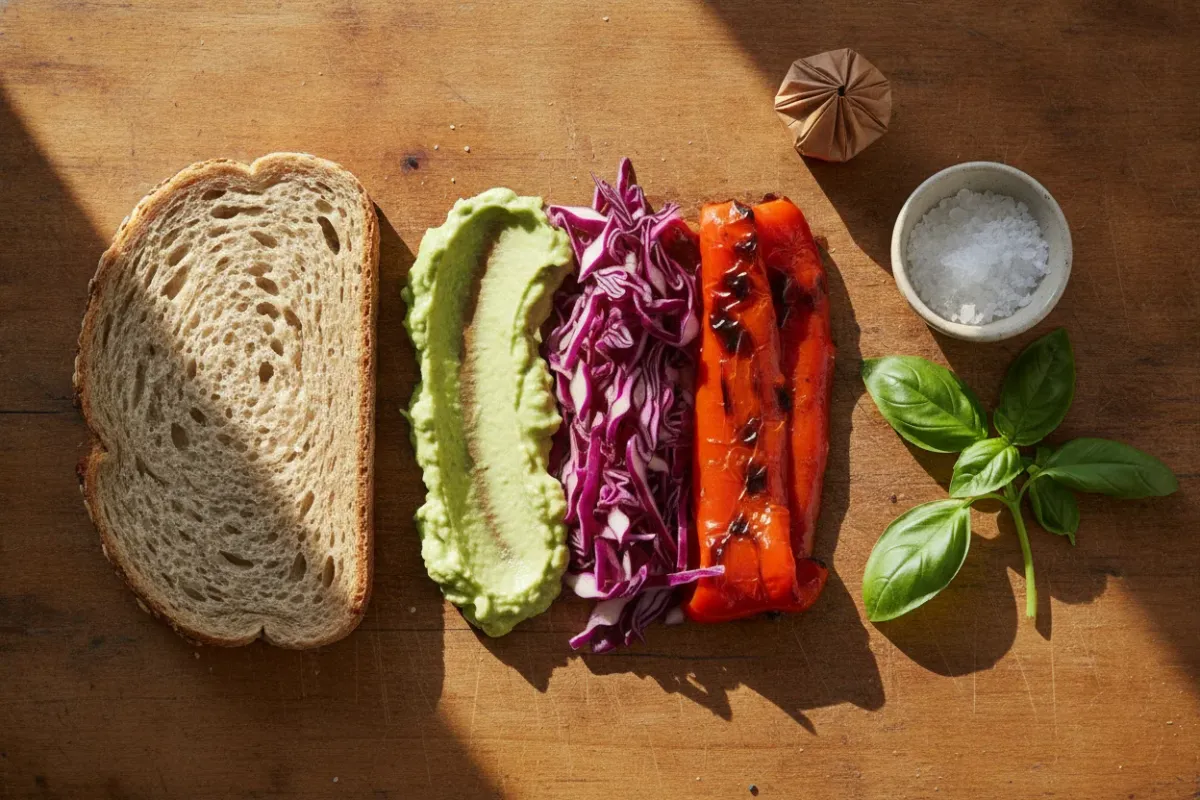
- Bottom bread + thin layer of hummus or avocado (barrier).
- Slice of cheese (second barrier + flavor).
- Protein (meat, fish, tofu, egg).
- Juicy ingredients (tomato, cucumber, pickled onion) — right here, in the middle, where moisture can't reach the bread.
- Crunchy ingredients (lettuce, sprouts, fresh herbs).
- Top bread + thin layer of mustard or yogurt sauce.
Seasoning: Season Every Layer
This is perhaps the most underrated secret. Most people salt and pepper their sandwich once — or don't season at all, hoping the saltiness of the meat will suffice. It won't.
As Bon Appétit recommends: "Season as you build! That means salting and peppering each tomato slice and each leaf of lettuce. And maybe adding a little olive oil and vinegar too."
This sounds excessive, but this is exactly how professional kitchens work. When each component is properly seasoned, the flavor is distributed evenly, and every bite is complete. If you season only one layer, some bites will be vibrant while others will be bland.
What to Season With
- Salt and pepper — the base. Sea salt flakes give a pleasant crunch.
- Olive oil + balsamic vinegar — for vegetables.
- Lemon juice — for avocado and fish.
- Dried herbs (oregano, thyme, basil) — for meat.
- Smoked paprika — adds depth without extra calories.
Vegetables: Clean and Dry
A small detail that changes everything. According to Gold Medal Bakery, all vegetables need to be "rinsed under running water and dried with paper towels" before slicing. Wet lettuce or damp tomatoes are a direct path to soggy bread.
Textural Contrast Through Vegetables
Vegetables are the main tool for creating textural contrasts:
- Crunch: fresh cucumber, radish, carrot (thinly sliced or grated), bell pepper.
- Juiciness: tomato (be sure to blot with a paper towel after slicing).
- Heat: pickled red onion, jalapeño, arugula.
- Freshness: lettuce leaves, microgreens, basil, cilantro.
Per Bon Appétit's recommendation, for flavor balance you should "cut through the richness of the meat with condiments like pickled red onion, sauerkraut, or briny capers." A sour or spicy accent works as a flavor "wake-up call" — it prevents your taste buds from getting used to monotony.
Macros: How to Make a Sandwich Part of a Healthy Diet
Here's an approximate breakdown for a classic healthy sandwich:
Basic Chicken and Vegetable Sandwich
| Ingredient | Weight | Kcal | P | F | C |
|---|---|---|---|---|---|
| Whole grain bread (2 slices) | 60 g | 150 | 6 | 2 | 26 |
| Chicken breast (boiled) | 80 g | 132 | 25 | 2.9 | 0 |
| Avocado (1/4) | 35 g | 56 | 0.7 | 5.2 | 3 |
| Tomato (3 slices) | 40 g | 7 | 0.4 | 0 | 1.4 |
| Cucumber | 30 g | 4.5 | 0.2 | 0 | 0.9 |
| Arugula | 10 g | 2.5 | 0.3 | 0.1 | 0.4 |
| Cheese (20% fat) | 20 g | 48 | 5 | 3 | 0 |
| Mustard | 5 g | 3 | 0.2 | 0.2 | 0.3 |
| Total | 280 g | ~403 | ~38 | ~13 | ~32 |
These are excellent numbers: high protein, moderate fats, enough carbohydrates for energy. And at the same time — a complete, delicious, satisfying meal.
Variations for Different Goals
- For bulking: add a second layer of meat and a slice of cheese → about 550 kcal.
- For cutting: remove the avocado, use fat-free cream cheese → about 320 kcal.
- For keto: replace bread with romaine leaves or "cloud bread" made from eggs and cream cheese → about 15 g carbs.
- For vegetarians: hummus + roasted vegetables + feta → about 380 kcal, 14 g protein.
Meal Prep: Sandwiches for the Week
A sandwich is an ideal candidate for meal prep, but with caveats. An assembled sandwich doesn't last longer than a few hours without losing texture. So it's better to prepare the components separately.
What You Can Prep in Advance
- Protein: roasted chicken, turkey, or tuna — in a container in the fridge for up to 3 days.
- Sauces: hummus, yogurt sauce, pesto — up to 5 days.
- Pickled vegetables: onion in vinegar, cabbage — up to 7 days.
- Bread: slice and freeze in portions. Take it out in the morning — by lunchtime it will have thawed and be perfect.
Morning Assembly Routine (3 minutes)
- Take out the bread (if from the freezer — it will thaw by lunch).
- Spread the barrier layer (hummus, avocado).
- Add the protein.
- Add dry vegetables (lettuce, cucumber).
- Juicy ingredients (tomato) — in a separate baggie, add before eating.
- Wrap in parchment or foil.
This way the sandwich will stay fresh and crunchy until lunch.
Sauces: A Small Component with Big Impact
Sauce is the binding element of the entire sandwich. Without it, the ingredients remain disjointed; with it — they become a unified dish.
Healthy Sandwich Sauces (per 1 tablespoon)
| Sauce | Kcal | What it adds |
|---|---|---|
| Dijon mustard | 5 | Heat and tanginess |
| Hummus | 25 | Creaminess and protein |
| Greek yogurt + garlic | 12 | Smoothness without extra fat |
| Pesto (homemade) | 40 | Bright herbal aroma |
| Guacamole | 23 | Healthy fats |
| Sun-dried tomato sauce | 15 | Deep umami flavor |
By combining two sauces — for example, mustard on the bottom bread and yogurt sauce on the top — you can achieve multi-layered flavor without a significant calorie increase.
Common Mistakes
Too Much Filling
A sandwich is not a burrito. If the filling spills out with every bite, there's too much of it. It's better to make two thin sandwiches than one unwieldy one.
Cold Ingredients on Hot Bread
If the bread has been toasted — let it cool for 30 seconds before adding lettuce. Otherwise the greens will wilt instantly.
Same Texture in All Layers
Soft bread + soft cheese + soft tomato = boring. Add at least one crunchy element — cucumber, radish, toast, or even a few nuts.
Neglecting the Edges
As Gold Medal Bakery notes, meat should be "spread so it fills the bread all the way to the edges." Empty edges mean bites of bread alone, and they ruin the impression of the entire sandwich.
Frequently Asked Questions
How do you prevent bread from getting soggy from juicy filling?
Apply a thin layer of a fatty product — mayonnaise, butter, hummus, or avocado — on both sides of the bread. Fat creates a waterproof barrier. Additionally, you can place a slice of cheese on top of each piece of bread — it also blocks moisture. Juicy ingredients (tomatoes, pickled vegetables) are best placed in the center of the sandwich, between dense layers.
How do you properly layer thinly sliced meat?
Don't lay the slices flat — slightly crumple or fold them, creating volume and airiness. This adds texture and visual appeal. Dense ingredients — meat, cheese — go closer to the bottom piece of bread, where they serve as an anchor for the entire structure.
How do you keep slippery ingredients (tomato, avocado) from "escaping"?
Place them between layers with high friction — for example, between lettuce leaves and meat. Lettuce works as a "cushion," holding smooth slices in place. Tomatoes can be lightly blotted with a paper towel before placing — this reduces sliding.
How do you season a sandwich so that every bite is flavorful?
Season each layer separately: salt and pepper on every tomato slice, a drop of olive oil on the greens, a pinch of paprika on the meat. If you season only one component, some bites will be bland while others will be over-seasoned.
How do you cut a sandwich without crushing it?
Use a sharp serrated knife and cut with a gentle sawing motion, without pressing down from above. You can stabilize the sandwich by gently pressing it with your palm, but without squeezing. Cut immediately after assembly, while the bread is still springy.
The perfect sandwich isn't about expensive ingredients or complex recipes. It's about attention to detail: the right moisture barrier, a thought-out layer order, seasoning at every level, and textural contrast. Try building your next sandwich using these principles — the difference will be noticeable from the first bite. And if you track your macros and choose quality ingredients, this simple format becomes a full-fledged part of a healthy diet — quick, delicious, and honest.
This article is for informational purposes only and is not medical advice. Consult a doctor or dietitian before making dietary changes.