Healthy Cookies with Your Child: A Sugar-Free Recipe with Full Nutrition Facts
Learn why baking sugar-free cookies with your child shapes their healthy eating habits. Simple recipe, full nutrition facts, and tips for kitchen success.
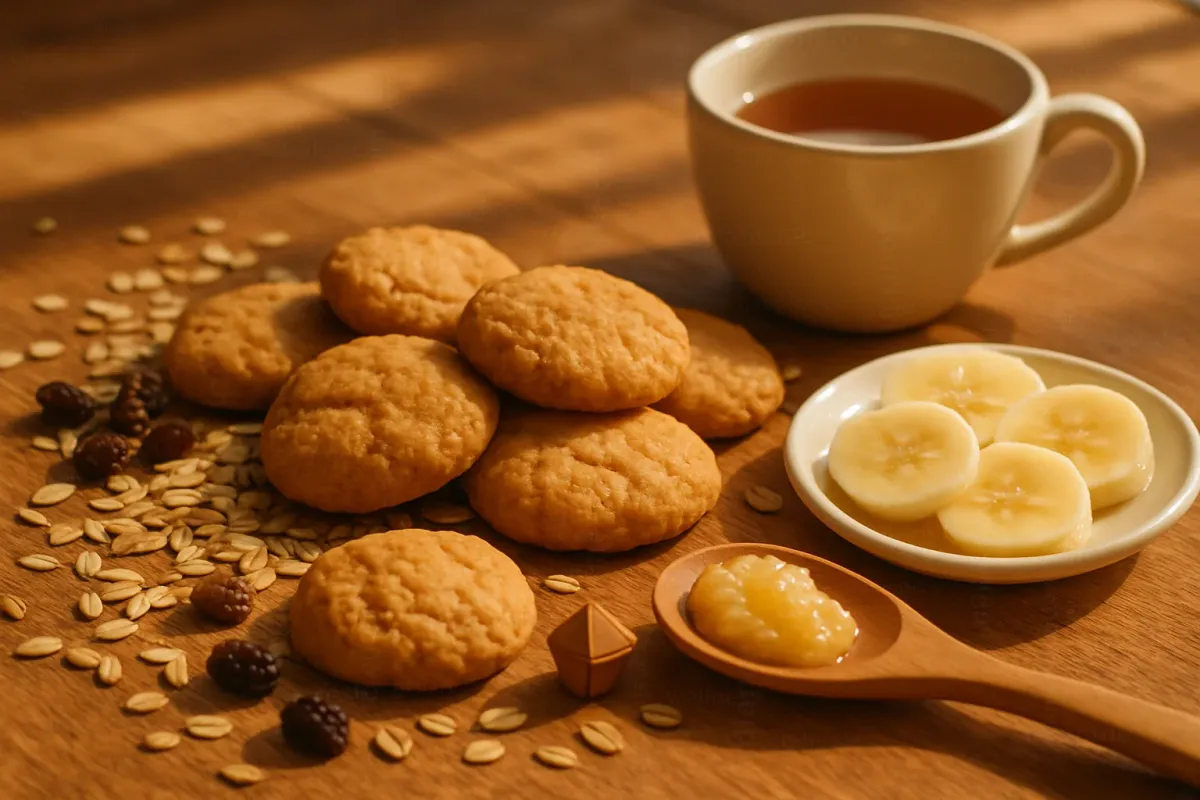
When a child bakes cookies on their own for the first time, it's more than a culinary episode. It's the moment when their relationship with food is shaped for years to come. And if that first cookie turns out to be not a store-bought mix with sugar as the first ingredient on the label, but a simple three-ingredient oat-banana dough — everyone wins: the child's health, family traditions, and evening tea.
Below is a complete breakdown: why baking together is healthier than it seems, a recipe even a five-year-old can handle, exact nutrition facts for each cookie, and techniques that turn kitchen chaos into pleasure.
Why Baking with Your Child Is About Health, Not Just Fun
Children Eat What They've Made Themselves
Every parent knows this observation: a child who turns up their nose at a banana on a plate proudly eats banana cookies if they mashed that banana with a fork themselves. Participating in cooking lowers wariness toward new foods — food stops being an "unfamiliar object" and becomes the result of one's own labor.
For families locked in an eternal battle over oatmeal, cottage cheese, or fruit, baking together is one of the gentlest ways to expand a child's diet without persuasion or "one spoonful for Mommy" deals.
The Kitchen Is a Screen-Free Training Ground
Measuring out a cup of oats, mashing a banana, rolling balls of equal size, waiting 20 minutes by the oven — each of these actions develops fine motor skills, counting, patience, and the ability to follow a sequence of steps. And all of it — without a tablet or cartoons.
The Habit of Reading Ingredient Labels Is Formed in Childhood
When a child sees that a cookie consists of banana, oats, and raisins — three understandable things — they form a basic understanding: food has ingredients, and the list can be short. That's far more valuable than any lecture about "harmful sugar." The World Health Organization recommends limiting free sugars to less than 10% of daily caloric intake, and ideally less than 5%. Home baking without added sugar is the most practical step in that direction: the sweetness comes from the fruit itself, not from white granules out of a bag.
The Recipe: Three-Ingredient Oat-Banana Cookies
This is exactly the recipe to choose for a child's first culinary experience. There are no raw eggs (the dough can be safely tasted), no mixer, no hot oil — just a bowl, a fork, and a baking sheet.
Ingredients for 16 Cookies
- Ripe bananas — 2 (about 240 g of flesh). The riper, the sweeter: bananas with brown spots on the peel — the ones nobody usually eats anymore — are ideal.
- Rolled oats — 160 g (about 2 cups). Regular old-fashioned oats work well — they hold their shape better than "quick" ones.
- Raisins — 30 g (a small handful). Can be replaced with pieces of dried apricot, berries, or dark chocolate chips — more on that below.
- Cinnamon — to taste (optional, but it adds a "bakery" aroma without a single calorie).
Nutrition Facts per Cookie (with a Yield of 16)
| Metric | Value |
|---|---|
| Calories | ~56 kcal |
| Protein | ~1.4 g |
| Fat | ~0.7 g |
| Carbohydrates | ~11 g |
For the entire batch of 16 cookies: approximately 890 kcal, protein 23 g / fat 11 g / carbs 174 g. Values are calculated from standard food composition data — you can verify the nutrition facts of any ingredient in the open USDA FoodData Central database.
For comparison: one classic shortbread cookie of the same size usually contains 2–3 times more calories and a noticeable share of saturated fat from butter. Here, fat is minimal, but there's fiber from the oats and potassium from the banana.
The Step-by-Step Process — with Roles for Your Child
Step 1. Mash the bananas. The peeled bananas go into a deep bowl, and the child mashes them with a fork until pureed. This is the favorite kids' part — mashing is officially allowed. Small lumps are no problem: in the finished cookies they'll turn into sweet little pockets.
Step 2. Add the oats. The adult measures (or, if the child is older, helps measure on a scale — number practice as a bonus), the child pours the oats into the banana puree and stirs. The dough comes out thick and slightly sticky — that's normal.
Step 3. Add the raisins and cinnamon. Here the child gets the right to choose: raisins, dried apricots, berries? The ability to decide for themselves is a powerful motivator that will later extend to "I'll pack myself a healthy snack for school."
Step 4. Let the dough rest for 10 minutes. The oats will absorb moisture from the banana, and the dough will become more manageable. These 10 minutes are a great moment to line the baking sheet with parchment together and preheat the oven to 180 °C (350 °F).
Step 5. Shape the cookies. With wet hands, the child rolls balls the size of a walnut and slightly flattens them on the baking sheet. The cookies don't spread or rise, so the shape "as molded" is the shape of the finished product. Crooked, uneven, with the imprint of a small palm — that's exactly what a first cookie should look like.
Step 6. Bake for 18–20 minutes at 180 °C until the edges are golden. The oven is the adult's zone, and this is worth stating in advance: the child sets the timer and watches through the glass, the adult takes out the baking sheet.
Step 7. Cool. The hardest 10 minutes in a young pastry chef's life. Hot cookies are fragile — after cooling they'll firm up and can be ceremonially taste-tested.
What Tasks to Entrust to Your Child: A Guide by Age
Ages 3–4
Washing bananas, peeling them, mashing with a fork (with help), pouring in pre-measured oats, stirring with a spoon. The adult's main task is to accept in advance that some of the oats will end up on the floor. That's the price of the investment.
Ages 5–7
Everything above plus measuring with a cup on their own, shaping the balls, working with the timer. At this age, children can already memorize the entire recipe and, after a couple of repetitions, "direct the process" themselves.
Ages 8–12
The full cycle under supervision, including weighing on a kitchen scale and — especially valuable — calculating the nutrition facts. The simple problem "if the whole batch has 890 kcal and we made 16 cookies, how much is in one?" is living math with a delicious answer. This way, counting calories is perceived from childhood not as a dietary punishment, but as ordinary kitchen arithmetic, like weighing flour.
Five Variations on the Base Recipe
The basic "banana + oats" dough is a construction kit. Here are proven directions:
1. The Protein Version
Add 30 g of protein powder (vanilla or chocolate) and 2–3 tablespoons of milk to compensate for the dryness. Protein per cookie rises to about 3 g — making it a proper snack after a workout or sports practice.
2. The Chocolate Version
A tablespoon of cocoa in the dough plus a few dark chocolate chips instead of raisins. Cocoa adds depth of flavor with almost no calories, and dark chocolate (70% and up) is the kind of sweetness dietitians consider a reasonable compromise.
3. The Nut Version
A tablespoon of sugar-free peanut butter in the dough. The calorie count per cookie will rise by about 6–7 kcal, but you gain healthy fats and a satiating effect — these cookies "hold" fullness longer.
4. The Apple-Carrot Version
Replace half the banana with finely grated apple or carrot (squeeze out the excess juice). A great move for kids who "don't eat vegetables": carrot in a cookie passes without negotiations.
5. The Keto Adaptation for Adults
For those who count carbs strictly: the banana is replaced with 100 g of pumpkin puree + a sweetener (erythritol or stevia), the oats with almond flour, plus an egg as a binder. This is a different recipe nutritionally (more fat, minimal carbs), but the "bowl — fork — baking sheet" logic remains.
Oats and Banana: What Nutrition Science Says
Oats are one of the most studied foods in nutrition science. Whole grains, which include rolled oats, contain beta-glucan — a soluble fiber that slows carbohydrate absorption and helps you stay full longer. The Harvard School of Public Health lists oats among foods with proven cardiovascular benefits — precisely thanks to beta-glucan.
The banana in this recipe holds three jobs at once: sweetener, binding agent (replacing egg and butter), and source of potassium. The sweetness of a ripe banana is exactly the kind of "sugars within a whole fruit" that the WHO does not classify as free sugars: they come along with fiber and nutrients, not empty calories.
The result: a cookie with not a single gram of added sugar, yet honestly sweet. For a child's palate not yet "recalibrated" by store-bought sweets, that's more than enough.
How to Store Them and Where to Take Them
- In an airtight container at room temperature — 2 days. The cookies are soft and moist, so they shouldn't be kept warm any longer.
- In the refrigerator — up to 5 days. Before serving, you can warm them for 10 seconds in the microwave — the fresh-baked softness comes back.
- In the freezer — up to 2 months. It's convenient to make a double batch on Sunday and take out 2–3 cookies for the school lunchbox: by lunchtime they'll have thawed on their own.
This is essentially kids' meal prep: one hour in the kitchen on the weekend covers snacks for the whole week — and the lunchbox holds not a store-bought bar with 20 grams of sugar, but a cookie with understandable ingredients and known nutrition facts.
Three Rules That Will Save the Adults' Nerves
Rule 1. Mess is part of the recipe. If you accept in advance that oat dust will be on the table and banana on cheeks, the process stops being irritating. A simple ritual helps: a large tray or silicone mat as the "work zone," and a damp towel at the ready.
Rule 2. The result is not graded. A crooked cookie gets praised just like a straight one. The goal of the first culinary experiences is not perfect shape, but the feeling of "I did it." Criticizing the shape at this stage kills the desire to cook more reliably than any failed recipe.
Rule 3. No fanaticism. Healthy cookies shouldn't become an ideology. If the child asks to add chocolate chips — that's a wonderful reason to add chocolate chips and calmly recalculate the nutrition facts together. Healthy eating is a default system, not a prohibition regime: a banana-oat dessert on weekdays coexists easily with cake at a birthday party.
Try It Yourself This Weekend
Everything you need is most likely already in the kitchen: two overripe bananas, a package of rolled oats, and forty minutes of time. Pick an evening when no one is in a hurry, hand the child a bowl and a fork — and let them do almost everything themselves.
You can label the box with the finished cookies: "Baked by: …" — and set it on the table for family tea. Experience shows: no adult dessert is eaten with as much pride as a 56-kilocalorie cookie made by little hands. And the habit of cooking simple, honest food, instilled at age five, is perhaps the longest-lasting "nutrient" of all.
This article is for informational purposes only and is not medical advice. Consult a doctor or dietitian before making dietary changes.