Calorie Traps in the USA: Food That Seems Normal
Discover calorie traps in USA food that seem normal. Why ordinary products contain 2-3x more calories than European alternatives.
Moving to America: Why the Scale Starts to Scare You
Moving to another country is always stressful. New language, new rules, new job. But there's one thing people rarely warn you about: food in America works completely differently. Not in taste — in calories. Products that look perfectly normal — a salad for lunch, a coffee on the way to work, a snack bar — in the USA can contain two to three times more calories than their counterparts in Russia or Europe.
This is not an exaggeration or a scare story. This is the reality that thousands of people who move to the States face. The first few months are an adaptation period when a person hasn't yet figured out local products, portion sizes, and ingredients. And it's precisely during this period that many people unknowingly gain anywhere from 5 to 15 kilograms.
Let's break down exactly which "normal" products in America are real calorie bombs, and how to deal with it without giving up enjoyment.
Portions: The Main Shock for a Newcomer
The first thing that catches your eye in American restaurants and cafés is the size of the plates. No, this isn't generosity. It's a system.
As the portal CalorieFinder notes, a standard restaurant portion in the USA is often two to three times larger than the officially government-recommended serving size. A standard "medium" soda at an American fast-food chain is a "large" or even "extra-large" by British or Japanese standards.
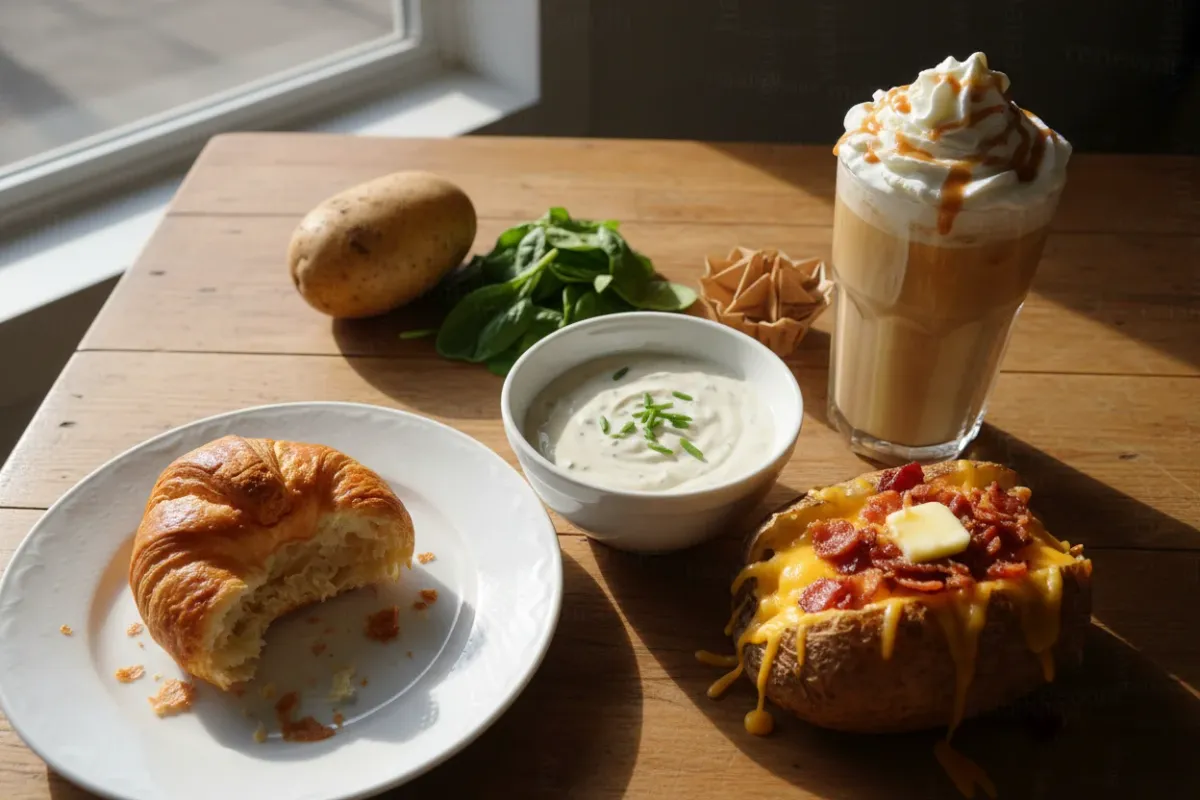
What does this mean in practice? A regular baked potato at home is about 150 kcal. A "Loaded Baked Potato" at a restaurant — the same potato, but with butter, cheese, bacon, and sour cream — easily exceeds 600 kcal. The difference is fourfold. Yet it looks like "just a potato."
The problem is that a person quickly gets used to the new portion sizes. After a couple of months, a "normal" plate from Russia starts to seem small. Your calibration shifts — and with it, your control over calories.
Latte: It's Not Just Coffee
Here's a typical morning: stop by Starbucks, grab a latte with oat milk. Seems harmless — it's just coffee, right? Wrong.
According to Daily Nutrition Tracker, a morning oat milk latte is about 340 kcal. For comparison: a cup of black coffee without additives is 2–5 kcal. The difference is 70-fold.
And if you add syrup (vanilla, caramel, pumpkin spice — America loves syrups), the calorie count of a single cup can climb to 400–500 kcal. That's a full meal's worth of calories, but without protein and with minimal nutrients.
Approximate calories and macros for an oat milk latte (grande, ~470 ml):
| Metric | Value |
|---|---|
| Calories | ~340 kcal |
| Protein | ~6 g |
| Fat | ~14 g |
| Carbs | ~48 g |
What could you eat for the same 340 kcal with far more benefit? A serving of oatmeal with a banana and a spoonful of peanut butter — with fiber, protein, and a feeling of fullness for 3–4 hours. A latte, on the other hand, is gone in 15 minutes, and an hour later you're hungry again.
Salads: The Illusion of a Healthy Choice
"I'll have the salad" — a phrase that in America can cost more (in calories) than a burger.
According to Daily Nutrition Tracker, a large Caesar salad is approximately 690 kcal. The dressing alone accounts for 280 kcal. That's more than a standard McDonald's cheeseburger (about 300 kcal).
How does that happen? Restaurant salads in the USA are not just leaves and vegetables. They include croutons (fried in oil), grated parmesan, bacon, avocado, and a generous portion of mayonnaise-based or olive oil-based dressing. As noted in a study by CaloriesScan AI, a serving of olive oil in an Italian or American salad is 2–3 tablespoons, which adds 300+ kcal to a single dish.
Approximate calories and macros for a restaurant Caesar salad (large portion):
| Metric | Value |
|---|---|
| Calories | ~690 kcal |
| Protein | ~30 g |
| Fat | ~50 g |
| Carbs | ~28 g |
Psychologically, the salad is perceived as a "light lunch." A person orders it, feels virtuous — and then wonders why the weight keeps climbing.
Granola and "Healthy" Bars
Granola is one of the sneakiest products in American supermarkets. Beautiful packaging, the words "organic," "whole grain," "natural" — and your hand is already reaching to put it in the cart.
According to My Food Data, homemade granola contains 597 kcal per cup (about 489 kcal per 100 g). Store-bought versions are often even more caloric due to added sugar, honey, and oil. Yet many people pour themselves a cup and a half or two cups without thinking — after all, it's a "healthy breakfast."
A granola bar is another trap. As Daily Nutrition Tracker notes, one "healthy" granola bar is about 250 kcal. That doesn't sound like much. But this small bar doesn't satisfy hunger — and an hour later you want another one. Two bars — that's already 500 kcal, with the feeling that you "didn't really eat anything."
Approximate calories and macros for granola (1 cup, ~120 g):
| Metric | Value |
|---|---|
| Calories | ~597 kcal |
| Protein | ~15 g |
| Fat | ~25 g |
| Carbs | ~78 g |
The My Food Data portal directly recommends checking the sugar content in granola — some brands contain it in unhealthy amounts.
Nut Butters: A Spoonful That Costs Dearly
Peanut butter is one of the symbols of American cuisine. People spread it on toast, add it to smoothies, eat it by the spoonful straight from the jar. And this is where the math begins.
A standard serving of peanut butter is 2 tablespoons (32 g). That's about 190 kcal, 16 g of fat, 7 g of protein. But who actually measures out exactly two tablespoons? Most people scoop it "by eye" — and by eye it comes out to 3–4 tablespoons. That's already 380–500 kcal — from peanut butter alone.
Almond butter is even more caloric: about 200 kcal for the same 2 tablespoons. Cashew butter is similar.
Macadamia nuts are the calorie champion among nuts. According to My Food Data, one ounce (28 g) of macadamia nuts is 204 kcal. For comparison: the same amount of almonds is 170 kcal, peanuts — 167 kcal.
Approximate calories and macros for peanut butter (realistic serving ~50 g):
| Metric | Value |
|---|---|
| Calories | ~295 kcal |
| Protein | ~12 g |
| Fat | ~25 g |
| Carbs | ~10 g |
Avocado: A Superfood with a Surprise
Avocado in America is practically a religion. Avocado toast, guacamole, avocado in salads, bowls, smoothies. It's an incredibly healthy product — packed with monounsaturated fats, fiber, and potassium. But its calorie count is unexpectedly high.
One whole avocado is 322 kcal, according to My Food Data. That's 160 kcal per 100 g. For a fruit — that's a lot. An apple of the same size is about 95 kcal.
An avocado toast at a café typically includes half an avocado (161 kcal) + bread (~120 kcal) + olive oil (~40 kcal) + a poached egg (~70 kcal) = approximately 390–450 kcal for one toast. Many people order two — and that's already 800–900 kcal for a breakfast that looks "light and healthy."
High-Fructose Corn Syrup: The Invisible Enemy
There's one thing that makes American food fundamentally different from European or Russian food: high-fructose corn syrup (HFCS).
As CalorieFinder explains, HFCS is the primary sweetener in the USA due to corn subsidies. It's found literally everywhere: in bread, ketchup, yogurts, sauces, "healthy" bars, and juices. Many travelers and immigrants note that HFCS-based products affect satiety and energy levels differently.
The caloric content of HFCS and regular sugar is roughly the same. But because portions are larger in the USA and HFCS is added to virtually everything, total sugar consumption increases imperceptibly yet significantly.
A practical tip: read the labels. If "high-fructose corn syrup" or "corn syrup" appears among the first ingredients — there's a lot of sugar in the product, even if it's marketed as "healthy."
Restaurant Dishes: The Oil You Don't See
One of the most insidious factors in American dining is hidden fats. Restaurant chefs generously use cooking oil, butter, and sauces because it makes dishes tastier.
According to the portal MacroLog, when counting calories in restaurant dishes, you should add 100–200 kcal (or 1–2 tablespoons of oil) to your estimate of any hot dish. This is the "invisible" oil that isn't listed on the menu and isn't detectable by taste.
And when it comes to ethnic cuisine dishes — things get even more interesting. As CaloriesScan AI notes:
- Thai curries made with coconut milk — 500–800 kcal per bowl, even though they look light
- Indian dishes (butter chicken, ghee-based curries, buttered naan) — 1,000+ kcal per serving
- Bubble tea and Asian milk teas — 400+ kcal per cup
All of these dishes don't look extreme on a restaurant menu. "Vegetable curry" sounds diet-friendly, right? But coconut milk is 230 kcal per cup, and a serving of curry uses far more than one cup.
Dairy Products: Caloric by Default
Whole milk (full fat) in America is the default standard. According to My Food Data, one cup of whole milk is 298 kcal. This doesn't mean milk is bad — it's just that in a situation where a glass of milk is added to breakfast cereal, then to coffee, then to baked goods — the calories add up.
For comparison: a cup of skim milk is about 90 kcal. The difference is 200 kcal. Over 30 days, from milk alone, that's 6,000 kcal — or nearly a kilogram of body fat.
Hidden 840 Calories in a Single Day
Here's a clear example of a typical day that Daily Nutrition Tracker provides as an illustration:
- Morning oat milk latte — 340 kcal (you thought: "just coffee")
- Dressing on the lunch salad — 280 kcal (you thought: "I'm eating a salad")
- A "healthy" snack (a bar, a handful of nuts) — 220 kcal (you thought: "it's barely anything")
Total: 840 hidden calories per day. These aren't main meals — these are "little things" that aren't perceived as food. Over a week — that's nearly 6,000 extra calories. Over a month — enough to gain about a kilogram.
How to Avoid the Calorie Trap: Practical Steps
Weigh and Measure — At Least for the First Month
Kitchen scales are your best friend in a new place. You don't need to weigh everything all the time. But for the first 3–4 weeks, it's worth checking yourself: how much does that "spoonful" of peanut butter actually weigh? What volume of granola are you pouring into your bowl? The results are often shocking.
Use Tracking Apps
According to MyFitnessPal, their database contains more than 20 million food items from around the world, including dishes from American restaurants and chains. The app supports barcode scanning and voice input. One user, Larry S., notes: "I weighed 307 lbs, and today I'm 198 lbs." Another user, Rohit S., emphasizes: "My main insight from MyFitnessPal is that I started understanding the food I eat. You don't need to follow trendy diets — you need to understand your goals and adjust your calories and macros to match them."
Order Sauces and Dressings on the Side
At most American restaurants, you can ask for "dressing on the side." This lets you control exactly how much sauce you add. The difference can be 200–300 kcal per meal.
Split Portions
American portions are essentially for two people by default. There's nothing strange about asking for a "to-go box" at the start of dinner and immediately setting half aside. Or splitting one dish between two people — in America, this is completely normal.
Cook at Home
This is obvious but the most effective advice. When a dish is prepared at home, every ingredient is under your control. Restaurant chicken is braised in oil — homemade chicken is baked in the oven. A restaurant salad comes with three tablespoons of dressing; a homemade one — with one. The difference is hundreds of calories every day.
Learn the "Hand" Rule for Estimating Portions
The portal MacroLog offers a simple method for estimating portions without scales:
- Palm — a serving of protein (approximately 20–30 g of protein, 100–120 g of meat)
- Thumb — a serving of fats (oil, nut butter, butter)
- Fist — a serving of carbs (grains, rice, pasta)
- Cupped hand — a serving of vegetables
This method isn't perfect, but in a restaurant where there are no scales, it helps you avoid being off by a factor of two or three.
Deceptive Foods: Summary Table
| Product | Seems Like | Actually |
|---|---|---|
| Oat milk latte | "Just coffee" | 340 kcal |
| Caesar salad (large) | "Light lunch" | 690 kcal |
| Cup of granola | "Healthy breakfast" | 597 kcal |
| Granola bar | "Small snack" | 250 kcal |
| Avocado (whole) | "Just a fruit" | 322 kcal |
| Peanut butter (3 tbsp) | "A little bit on toast" | ~285 kcal |
| Butter chicken + naan | "Regular lunch" | 1,000+ kcal |
| Bubble tea / milk tea | "A drink" | 400+ kcal |
| Loaded baked potato | "Just a potato" | 600+ kcal |
| Glass of whole milk | "A glass of milk" | 298 kcal |
Adapting Without Panic
It's important to understand: the goal is not to fear American food or to live on lettuce leaves. The goal is to understand what's actually behind familiar-looking products. Knowledge is control. When a person knows that a latte is 340 kcal, they don't give up the latte. They simply factor it into their daily balance.
America is a country of enormous food diversity. You can eat incredibly healthily here: fresh farm vegetables, quality proteins, an amazing selection of spices and superfoods. You just need to recalibrate your perception filter: don't trust the portion size, read the labels, control the dressings and sauces.
The first couple of months after moving are the most important. This is exactly when new eating habits are formed. If you set the right benchmarks from the start — track calories and macros, cook at home, approach restaurant food mindfully — you can enjoy everything America has to offer without extra kilograms on the scale.
Frequently Asked Questions
How much peanut butter is a "normal" serving, and how much do people actually use?
The recommended serving is 2 tablespoons (32 g, ~190 kcal). In reality, most people use 3–4 tablespoons, which doubles the calorie count to 380–500 kcal. The best way to check yourself is to weigh your "usual" spoonful on kitchen scales just once.
Can two foods with the same calorie count affect hunger and metabolism differently?
Yes, and this is a key point. 300 kcal from chicken breast with vegetables provides protein, fiber, and lasting satiety. 300 kcal from a latte with syrup is fast carbs and fats, after which hunger returns within an hour. The calories are the same, but the macronutrient composition and dietary fiber make them completely different in their effect.
Why is granola marketed as a healthy product if one cup contains almost 600 calories?
Granola does contain beneficial ingredients — oats, nuts, seeds. But manufacturers often add significant amounts of sugar, honey, and oil to improve taste and texture. The My Food Data portal directly recommends checking the sugar content on the label. The solution is to use granola as a topping (2–3 tablespoons) rather than as the base of your breakfast.
How can you tell a genuinely healthy product from a marketing gimmick?
The only reliable way is to read the Nutrition Facts label. Look not at the front of the package ("organic," "natural," "low fat") but at the back: calories per serving, serving size, sugar and fat content. If a "healthy" bar has 20 g of sugar — it's no longer a healthy product, no matter how attractive the packaging.
This article is for informational purposes only and is not medical advice. Consult a doctor or dietitian before making dietary changes.