Protein Bar Alternatives: 12 Healthy Options Without Excess Sugar
Tired of hidden sugar in protein bars? Explore 12 nutritious alternatives that deliver real nutrition without artificial ingredients or excess sugar.
Why Store-Bought Bars Aren't Always a Good Choice
Protein and granola bars have become a symbol of the "healthy snack." They're easy to toss in a bag, they curb hunger, and they look like a mindful choice. But if you flip the package over and read the ingredients, the picture often changes.
As noted by Remedy's Nutrition, many commercial protein bars "contain more than 10 grams of added sugar, artificial flavors, and long lists of preservatives that negate their health benefits." In essence, what's marketed as a fitness product often turns out to be a confection in a bright wrapper labeled "protein."
There are three key reasons to consider alternatives:
- Hidden sugar. Even "healthy" bars can contain as much sugar as a candy bar from the supermarket. The only difference is that the sugar is hidden under names like "rice syrup," "agave syrup," or "fruit juice concentrate."
- Energy spikes. According to the same source, typical on-the-go snacks "often contain refined carbohydrates and sugars," which "causes a quick burst of energy followed by a crash." In other words, an hour after eating the bar, you're hungry again.
- Cost. A single protein bar costs between 100 and 300 rubles. Over a month of daily snacking, that adds up to 3,000 to 9,000 rubles — for something you could make at home for significantly less.
For daily use, "whole foods — nuts, eggs, or yogurt — are generally a better choice both nutritionally and budget-wise," as Remedy's Nutrition rightly points out.
Natural Whole-Food Snacks
The simplest approach is to ditch the "bar" format altogether and switch to foods that don't require a recipe. Here are specific ideas with approximate calorie and macro values.
Nuts and Dried Fruits
Raw nuts are a time-tested classic. According to a discussion on Reddit, many people who've ditched bars have switched to buying nuts in bulk: cashews, hazelnuts, pistachios, almonds. They complement them with unsweetened dried fruits without added oil.
One serving of almonds (30 g, ~23 nuts):
- Calories: 164 kcal
- Protein: 6 g
- Fat: 14 g
- Carbs: 6 g
One serving of cashews (30 g, ~18 nuts):
- Calories: 157 kcal
- Protein: 5 g
- Fat: 12 g
- Carbs: 9 g
Nuts provide healthy fats, fiber, and sustained energy — without blood sugar spikes. It's convenient to portion them into small bags for the week ahead and keep them in your bag or on your desk.
The "Protein + Produce" Formula
Dietitian Bridget Reiter (MS, RDN) recommends the so-called "P+P combination" — protein + produce. This principle is described in a piece by the American Institute for Cancer Research (AICR). The idea is simple: combining protein and fiber helps you feel full longer, which reduces the likelihood of overeating.
Specific combinations:
| Protein component | Produce component | Approximate macros per serving |
|---|---|---|
| Hummus (2 tbsp) | Carrot sticks (100 g) | ~110 kcal, 4 g P, 5 g F, 13 g C |
| Peanut butter (1 tbsp) | Banana (1 medium) | ~200 kcal, 5 g P, 8 g F, 30 g C |
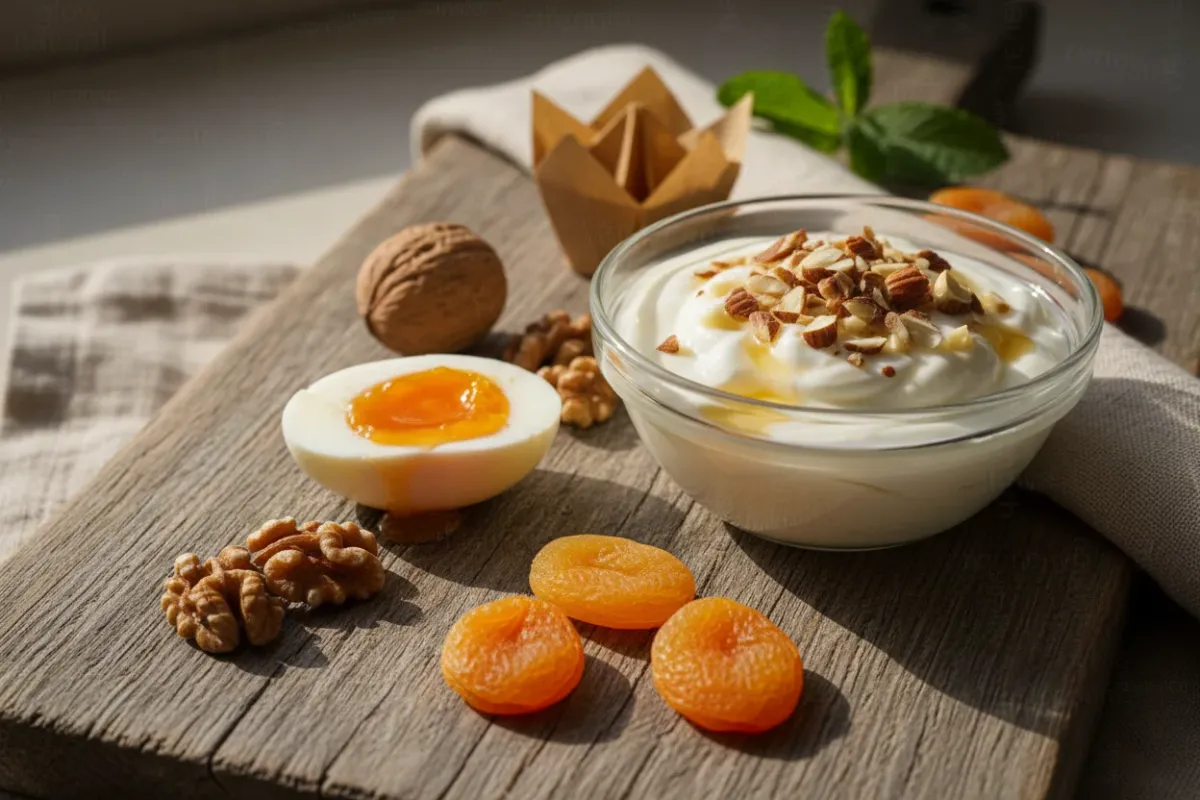
| Greek yogurt (150 g) | Berries (100 g) | ~130 kcal, 15 g P, 1 g F, 15 g C |
| Hard-boiled eggs (2) | Cucumber + tomato | ~160 kcal, 13 g P, 10 g F, 5 g C |
According to the same AICR source, research shows that snacks account for about a third of the average person's daily calorie intake. So the quality of your snacks isn't a minor detail — it's a third of your entire diet.
Greek Yogurt as a Base
Greek yogurt deserves special mention — it contains nearly twice as much protein as regular yogurt, as noted by Healthline. This makes it a versatile snack base:
- With nuts and seeds — for satiety
- With berries and cinnamon — for sweetness without sugar
- With homemade granola — for a crunchy texture
Greek yogurt 2% (200 g):
- Calories: ~130 kcal
- Protein: 20 g
- Fat: 4 g
- Carbs: 7 g
Chia Pudding
Another powerful snack that you prepare in advance and it waits for you in the fridge. According to Healthline, if you make chia pudding with cow's milk (240 ml), that adds 8 g of protein; with soy milk — about 7 g depending on the brand.
Chia pudding (200 g, made with 2% milk):
- Calories: ~210 kcal
- Protein: 10 g
- Fat: 10 g
- Carbs: 20 g
The preparation is dead simple: pour 3 tablespoons of chia seeds into 200 ml of milk, stir, and leave in the fridge overnight. In the morning, add berries or a spoonful of honey.
Homemade Bars: Simple No-Bake Recipes
If you still like the bar format — convenient to carry, easy to portion — there are excellent no-bake recipes. As the author of the blog Love and Lemons aptly put it: "You can buy a million different bars today, but homemade ones are still better. It's more affordable, and you know exactly what you're eating: whole foods — oats, nuts, seeds — and no additives or preservatives."
Recipe #1: Basic No-Bake Protein Bar
This recipe is adapted from several sources and has been tested in practice.
Ingredients:
- Rolled oats (not instant) — 200 g
- Peanut butter — 260 g
- Honey or maple syrup — 60 ml
- Milk (any kind) — 120 ml
- Protein powder (chocolate) — 70 g
- Vanilla extract — 1 tsp
Directions:
- Mix the protein powder and rolled oats in a large bowl.
- In a separate container, combine the nut butter, milk, honey, and vanilla. Warm slightly so the butter becomes pourable.
- Pour the wet mixture into the dry mixture. Stir until uniform.
- Transfer the mixture to a 20×20 cm pan lined with parchment paper. Press down firmly.
- Refrigerate for at least 1 hour until fully set.
- Cut into 12 bars.
As the recipe author at The Big Man's World advises, it's best to cut with a warm sharp knife (hold it under hot water) — this gives you a clean, neat cut.
Macros per bar (12 servings):
- Calories: ~220 kcal
- Protein: 12 g
- Fat: 10 g
- Carbs: 22 g
According to Love and Lemons, homemade bars like these keep in the fridge for up to a week and in the freezer for up to 2 months. This makes them ideal for meal prep.
Recipe #2: Honey-Peanut Crunch Bars
This variation is adapted from a recipe by Detoxinista.
Ingredients:
- Rolled oats — 180 g (you can substitute 45 g of oats with 50 g of puffed rice for a crunchier texture)
- Protein powder — 40 g
- Hemp hearts — 30 g
- Pinch of salt
- Honey — 80 ml
- Peanut butter — 80 g
- Coconut oil — 30 ml
Directions:
- Mix the oats, protein powder, hemp hearts, and salt.
- Bring the honey to a boil over high heat. Once it boils, time exactly 1 minute — this is the key step for the right texture.
- Remove from heat, add the peanut butter and coconut oil. Stir until smooth.
- Pour into the dry mixture and mix quickly and thoroughly.
- Press into a 20×20 cm pan lined with parchment paper.
- Chill in the fridge for about 1 hour.
- Cut into 12 full-size bars or 24 mini portions.
Macros per bar (12 servings):
- Calories: ~175 kcal
- Protein: 8 g
- Fat: 8 g
- Carbs: 20 g
Recipe #3: Chocolate-Peanut Butter Bars in 10 Minutes
The most minimalist option, inspired by a recipe from CakeWhiz.
Ingredients:
- Rolled oats — 150 g
- Shredded coconut — 30 g
- Peanut butter — 130 g
- Honey — 80 ml
- Chocolate chips (dark chocolate) — 40 g
- Optional: 2 tbsp protein powder, chia seeds, or flaxseeds
Directions:
- Warm the peanut butter with honey in the microwave for 30–40 seconds until pourable.
- Add the oats, coconut, and chocolate chips. Mix together.
- Transfer to a 20×20 cm pan lined with parchment paper. Press down firmly.
- Refrigerate overnight (or at least 3–4 hours).
- Cut into portions.
Macros per bar (12 servings):
- Calories: ~165 kcal
- Protein: 5 g
- Fat: 9 g
- Carbs: 18 g
The honey in any of these recipes can be replaced with maple syrup; as CakeWhiz notes, some people even use molasses — but that's an acquired taste.
Energy Balls: A One-Bite Snack
Energy balls are another popular alternative mentioned by Love and Lemons. Essentially, they're the same as bars but in the format of portioned balls. The advantage is that you don't need a pan and don't need to cut anything.
Basic recipe (20 balls):
- Pitted dates — 200 g
- Rolled oats — 100 g
- Peanut butter — 3 tbsp
- Cocoa powder — 2 tbsp
- Chia seeds — 1 tbsp
Blend everything in a food processor, roll into balls, and refrigerate.
Macros per ball:
- Calories: ~75 kcal
- Protein: 2 g
- Fat: 3 g
- Carbs: 10 g
To boost the protein, you can add 2–3 tablespoons of protein powder or replace some of the oats with nut flour.
How to Choose a Store-Bought Bar When You Don't Have Time to Cook
There are days when you have neither the time nor the energy to cook. In those cases, a store-bought bar isn't a crime. The key is knowing how to read the label.
According to Remedy's Nutrition, when choosing a bar you should pay attention to three things:
- A short ingredient list. If the ingredients take up half the package — that's already a red flag.
- Minimal added sugar. Aim for no more than 5–6 g per serving.
- Whole protein sources at the top of the list. Nuts, seeds, egg white, whey protein — good. "Soy protein isolate" in tenth place after sugar syrup — not so good.
Meal Prep: A Weekly Snack Plan
For bar alternatives to actually work, you need to prepare them in advance. Here's a specific Sunday prep plan that will cover your snacks for the entire work week:
| What to prepare | Time | Storage | How long it lasts |
|---|---|---|---|
| A batch of bars (12 pcs.) | 15 min + 1 hour in the fridge | Fridge — 7 days, freezer — 2 months | 5–6 days |
| Energy balls (20 pcs.) | 10 min | Fridge — 5 days | 5 days |
| Chia pudding (3 servings) | 5 min | Fridge — 3 days | 3 days |
| Portioned nut bags (5 pcs.) | 5 min | Room temperature | 5 days |
| Sliced veggies + hummus | 10 min | Fridge — 4 days | 4 days |
In total — about 45 minutes on Sunday, and you'll have a variety of healthy snacks for the entire week without a single store-bought bar.
Comparison: Store-Bought Bar vs. Homemade Alternatives
| Parameter | Store-bought protein bar | Homemade bar | Nuts + fruit |
|---|---|---|---|
| Protein per serving | 15–25 g | 8–20 g | 5–6 g |
| Added sugar | 5–15 g | 3–8 g (honey) | 0 g |
| Preservatives | Yes | No | No |
| Cost per serving | 100–300 ₽ | 30–50 ₽ | 40–70 ₽ |
| Prep time | 0 min | 15 min per batch | 0 min |
| Shelf life | Months | 1–2 weeks | Weeks |
| Ingredient control | Minimal | Full | Full |
As the table shows, homemade alternatives win on most parameters. The only area where store-bought bars truly lead is convenience and high protein content in a compact form. But if you add quality protein powder to a homemade recipe, the gap narrows.
Frequently Asked Questions
Can I substitute almond butter for peanut butter?
Absolutely. Almond butter, cashew butter, and even sunflower seed butter all work the same way in these recipes. The texture and setting time may differ slightly, but the principle remains the same. For those with allergies, sunflower seed butter is the best option.
What can I use instead of hemp hearts?
Hemp hearts can be replaced with shelled sunflower seeds, pumpkin seeds, or ground flaxseed. All of these options provide additional protein and healthy fats. The ratio is one to one.
What can I use instead of dates as a binder?
In energy ball recipes, dates serve as the main "glue." They can be replaced with thick honey, prune paste, or a ripe banana. Keep in mind that with banana the texture will be softer, and the balls should be stored only in the fridge.
How do I make bars completely gluten-free and still high in protein?
Replace the rolled oats with certified gluten-free oats (they do exist — regular oats may contain traces of gluten due to cross-contamination). The second option is to use puffed rice or buckwheat flakes. To boost protein, add more protein powder or nut flour.
What can I use instead of flaxseeds if I'm allergic?
Chia seeds are the closest substitute in both function and nutritional profile. Ground sunflower or pumpkin seeds also work. If flax was used as a binder (ground flax + water), it can be replaced with ground chia seeds in the same proportion.
Switching from store-bought bars to homemade snacks isn't about sacrificing convenience. It's about knowing exactly what goes into your body, saving money, and still eating well. You can start with just one recipe this Sunday — and within a week, store-bought bars will simply stop being necessary.
This article is for informational purposes only and is not medical advice. Consult a doctor or dietitian before making dietary changes.