Healthy Eating When Your Parents Buy the Groceries
Want to eat healthy but parents buy groceries? Learn practical steps to build a balanced diet at home—no conflict, no starving. Teen guide.
A Familiar Situation: You Want to Eat Healthy, but the Fridge Decides for You
Wanting to switch to healthy eating is great. But what do you do when the shopping list is made not by the person who wants to count calories and macros and eat more vegetables, but by mom or dad? When the fridge is stocked with hot dogs, white bread, and mayonnaise, but you're dreaming of chicken breast, avocado, and whole-grain crackers?
This is one of the most common situations for teenagers and young adults living with their parents. And the key thing to understand here is this: even with the set of foods already available at home, you can build a smart and balanced diet. And if you approach the issue wisely, you can gently influence the family grocery basket too.
This article is a step-by-step guide for those who want to eat more mindfully but don't yet control the budget and shopping. No conflicts, no fanaticism, no starving.
Why Parents Buy What They Buy
Before trying to change anything, it's worth understanding your parents' logic. They're not enemies of healthy eating — they simply have different priorities and habits.
Budget and Time
A study from the University of Georgia found that parents with lower income levels and more children more often feel overwhelmed, which directly affects the family's diet quality. Economic instability is one of the constant stressors, and buying familiar, inexpensive products is a way to save both time and money.
Habits and Food Traditions
According to a study published in the journal Appetite, children whose parents regularly consume fruits and vegetables are more likely to adopt similar eating habits. This works in reverse too: if parents grew up on fried potatoes and dumplings, those are the foods that seem normal and proper to them.
Control and Care
Sometimes parents buy certain products with the best intentions, but in a directive control format. A study from the University of Minnesota (HOME Plus study), published in the journal Appetite, found that strict control over a child's diet — such as banning certain foods or forcing them to finish their plate — can lead to unhealthy eating habits and weight gain over time. In contrast, a non-directive approach — where parents lead by example and make healthy food accessible — is associated with increased consumption of nutritious foods.
Understanding these reasons is the first step. You don't need to go to war. You need to find common ground.
Step 1: Audit What's Already at Home
Before asking your parents to buy something new, take a close look at what's already in the fridge and cabinets. Often, among the usual products, there are perfectly decent options hiding in plain sight.
What to Look for in Kitchen Cabinets
- Grains: buckwheat, oatmeal, rice (brown is better, but white works too) — excellent sources of complex carbohydrates
- Legumes: peas, lentils, canned beans — plant-based protein and fiber
- Pasta: yes, even regular pasta can fit into a healthy diet if you control the portion size
- Canned goods: tuna in its own juice, pink salmon, beans — quick protein
- Oil: sunflower or olive — healthy fats for cooking
What to Look for in the Fridge
- Eggs — a versatile product, one of the best protein sources. Two boiled eggs: ~140 kcal, 12 g protein, 10 g fat, 1 g carbs
- Cottage cheese — if available, it's a real find. 200 g of low-fat cottage cheese: ~140 kcal, 24 g protein
- Kefir, ryazhenka — fermented dairy products, good for digestion
- Frozen vegetables — often sitting forgotten in the freezer. Broccoli, green beans, mixed vegetables — all work great
As the American Heart Association notes, fresh, frozen, canned, and dried fruits and vegetables are all good choices. Frozen vegetables are nearly equal to fresh ones in nutritional value.
Make a List of "What's Available" and "What's Missing"
Grab a notebook or a note on your phone. Write down everything useful you found. In a separate column, note what's missing for a complete diet. This list will come in handy for the conversation with your parents.
Step 2: Learn to Cook with What's Available
The most powerful tool for healthy eating isn't a shopping list — it's knowing how to handle ingredients. From the same set of ingredients, you can make both an unhealthy and a healthy meal. The difference is in the cooking method.
Swaps That Don't Require New Purchases
| Instead of this | Do this | Calorie savings |
|---|---|---|
| Fried potatoes in oil | Baked potato wedges in the oven with minimal oil | ~150–200 kcal per serving |
| Sandwich with sausage and mayo | Sandwich with egg and cucumber | ~100–150 kcal |
| Porridge with milk and sugar | Porridge with water/milk and banana | ~50–80 kcal |
| Pasta with hot dogs | Pasta with stewed vegetables and egg | ~100 kcal, +fiber |
| Tea with 3 spoons of sugar | Tea with 1 spoon of honey or no sugar | ~40–80 kcal per cup |
As the American Heart Association recommends, you should take "small steps, gradually replacing less healthy ingredients with more nutritious ones in favorite family dishes." Use herbs, spices, citrus, and salt-free seasonings instead of excess oil and salt.
Five Meals You Can Make from "Ordinary" Products
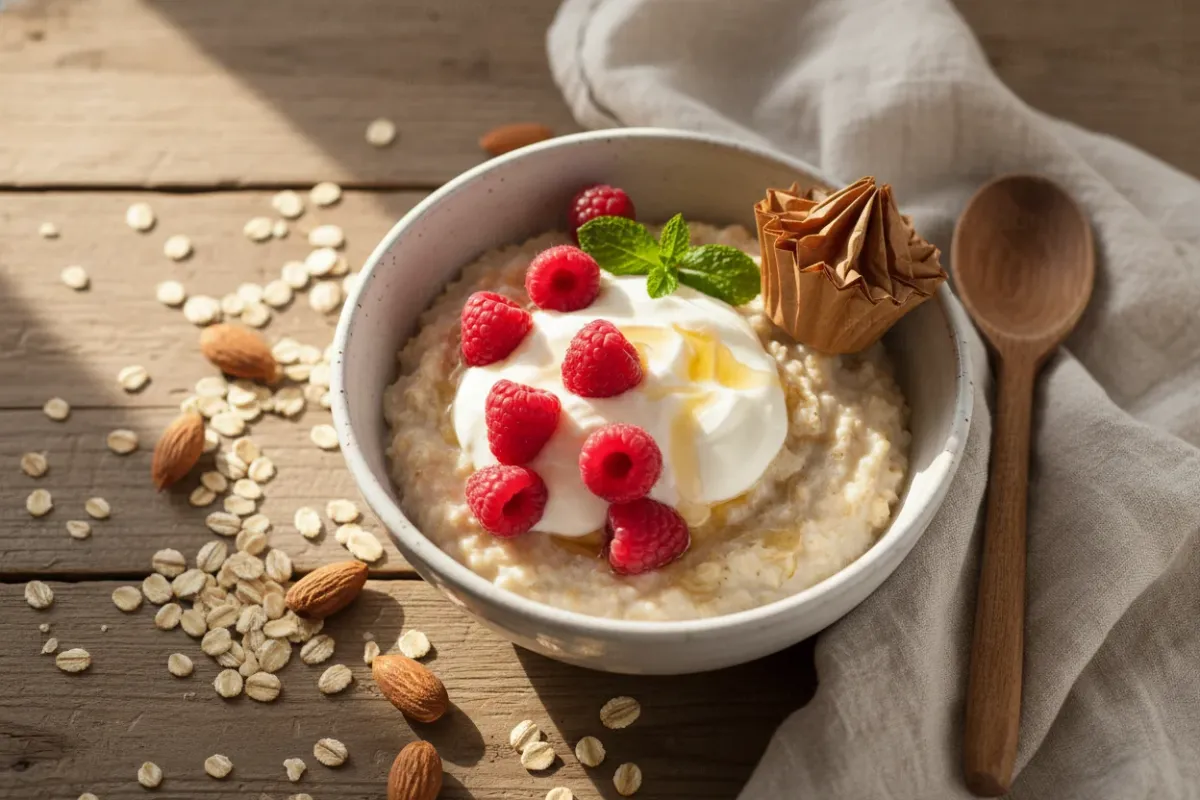
1. Oatmeal with Banana and Cinnamon Oat flakes (50 g) + water or milk + banana + a pinch of cinnamon. Nutrition per serving: ~280 kcal | P: 8 g | F: 4 g | C: 52 g
2. Buckwheat with Egg and Vegetables Buckwheat (80 g dry) + 2 boiled eggs + cucumber or tomato. Nutrition: ~420 kcal | P: 22 g | F: 12 g | C: 55 g
3. Cottage Cheese with Berries (or Jam — Just a Little) Cottage cheese 5% (200 g) + a handful of berries or 1 teaspoon of jam. Nutrition: ~210 kcal | P: 24 g | F: 6 g | C: 16 g
4. Pasta with Tuna and Vegetables Pasta (80 g dry) + a can of tuna in its own juice + frozen vegetables. Nutrition: ~400 kcal | P: 30 g | F: 3 g | C: 62 g
5. Omelet with Vegetables 3 eggs + milk (50 ml) + tomato + herbs, with minimal oil. Nutrition: ~270 kcal | P: 20 g | F: 18 g | C: 6 g
According to CDC (Centers for Disease Control and Prevention) recommendations, when snacking, you shouldn't eat directly from the package — it's better to portion out the right amount onto a plate or into a container. This is a simple habit that helps with portion control.
Step 3: Talking to Your Parents — How to Ask Without Conflict
This is the most delicate part. The phrase "Mom, you only buy junk food" is a path to an argument, not to avocado in the fridge. Here are strategies that work.
The "Add, Don't Remove" Approach
Don't ask them to remove familiar products. Ask them to add new ones. This is a fundamentally different message.
Not: "Stop buying white bread"
Yes: "Mom, could you also grab some whole-grain bread next time? I want to try it"
Not: "Hot dogs are poison"
Yes: "Could we sometimes get chicken breast? I'll cook it myself"
The "I'll Help" Approach
Offer specific help. Parents get tired — and if a kid takes over some of the cooking, it makes life easier for the whole family.
- "How about I cook dinner on Tuesdays and Thursdays?"
- "I'll make a list — can you pick up these items when you go to the store?"
- "Can I come to the store with you? I want to pick out a couple of things"
Researcher Katie Loth from the University of Minnesota notes: "When the healthy choice becomes the easy choice at home, parents don't need to create and enforce as many rules around food". The goal is to simply make healthy products accessible.
The "Let's Do It Together" Approach
A study published in the Journal of Nutrition Education and Behavior found that parental involvement in cooking together significantly correlates with fruit and vegetable consumption in children. Suggest cooking together — it's both quality family time and an opportunity to introduce new foods into the diet.
What You Definitely Should NOT Do
- Criticize what your parents cook and buy
- Demonstratively refuse family meals
- Call homemade food "unhealthy" or "junk"
- Go on a strict diet without consulting a doctor
Step 4: Snack Strategy — A Zone You Can Control
Even if parents determine the main meals, snacks are territory where you can act independently. A small budget (pocket money, part-time job) allows you to stock up on basic healthy snacks.
Budget-Friendly Healthy Snacks
| Product | Approximate price | Nutrition per serving |
|---|---|---|
| Banana (1 pc.) | 15–20 ₽ | 105 kcal, P: 1 g, F: 0 g, C: 27 g |
| Carrot (1 medium) | 5–10 ₽ | 35 kcal, P: 1 g, F: 0 g, C: 8 g |
| Apple (1 medium) | 20–30 ₽ | 80 kcal, P: 0 g, F: 0 g, C: 21 g |
| Kefir 1% (250 ml) | 35–50 ₽ | 100 kcal, P: 7 g, F: 2.5 g, C: 10 g |
| Whole-grain crackers (2 pcs.) | 10–15 ₽ | 60 kcal, P: 2 g, F: 0.5 g, C: 12 g |
| Boiled egg (1 pc.) | 10–15 ₽ | 70 kcal, P: 6 g, F: 5 g, C: 0.5 g |
The CDC recommends as healthy snacks canned fruit with no added sugar, low-fat yogurt with no added sugar, and whole-grain crackers.
Weekly Meal Prep on Pocket Money
If you can spend 300–500 rubles a week on yourself, here's what you can buy:
- A pack of oatmeal (60–80 ₽) — enough for 10 breakfasts
- 10 eggs (90–120 ₽) — protein for the week
- A pack of buckwheat (80–100 ₽) — a side dish for several days
- 1 kg of bananas (80–100 ₽) — snacks
- 2 packs of cottage cheese (120–160 ₽) — protein snacks
Total: about 450 ₽ — and you've got a basic set of healthy foods for the week.
Step 5: Nutrition Tracking — Control Without Scales and Kitchen Gadgets
You don't need to weigh every gram of food. It's enough to keep a food diary and roughly understand what and how much you've eaten during the day.
The Hand Method for Estimating Portions
- Protein (meat, fish, cottage cheese): a portion the size of your palm (~100–120 g)
- Carbohydrates (grains, pasta): a portion the size of your fist (~150–200 g cooked)
- Vegetables: two palms — the minimum for one meal
- Fats (oil, nuts): a portion the size of your thumb (~15 g)
Tracking Apps
Free apps help track calories and macros without obsessive counting:
- FatSecret — large food database, includes Russian products
- MyFitnessPal — popular international app
According to familydoctor.org recommendations, whole-grain products should be listed as the first ingredient on the label — they're rich in fiber and help you feel full longer, preventing overeating. Learn to read labels — it's a skill that will serve you for a lifetime.
Step 6: Shape the Food Environment Around You
Even while living with your parents, you can create your own micro-environment of healthy eating.
Practical Tips
Your own shelf in the fridge. Ask for one shelf or container where your prepped foods will be stored — cut vegetables, boiled eggs, cottage cheese. When healthy food is within reach and ready to eat, choosing it happens automatically.
Serving on individual plates. The CDC recommends serving food on individual plates instead of placing shared dishes on the table — this helps avoid second and third helpings. If your family typically eats from a shared pan, try portioning out the right amount onto your own plate.
Water instead of juice and soda. One of the simplest swaps. A liter of juice is 400–500 kcal of empty carbs. A liter of water is 0 kcal. Place a water bottle on your desk or next to your bed.
The half-plate method. The American Heart Association recommends filling half your plate with fruits and vegetables at every meal. Even if dinner is cutlets with mashed potatoes, add a cabbage or cucumber salad alongside. Vegetables are almost always available at home.
Step 7: Gradual Changes for the Whole Family
The best strategy is not revolution, but evolution. Small changes that stick.
A 4-Week Plan
Week 1: Observation. Write down everything you eat. Don't change anything — just record it. This will give you an objective picture.
Week 2: One swap. Replace one meal or snack with a healthier option. For example, a morning sausage sandwich → oatmeal with banana.
Week 3: Add vegetables. Add a serving of vegetables to every lunch and dinner — fresh, stewed, or frozen. Don't remove the main dish, just add to it.
Week 4: Suggest it to the family. Cook something new and healthy for the whole family. Make it something tasty — for example, roasted chicken with vegetables or homemade oat pancakes.
Research shows that repeated exposure to healthy foods leads to their gradual acceptance. This works with adults too: if mom tries your cottage cheese dessert and it turns out to be delicious, she'll start buying cottage cheese on her own.
Sample Daily Meal Plan from "Ordinary" Home Products
| Meal | Dish | Nutrition |
|---|---|---|
| Breakfast | Oatmeal on water with banana and cinnamon | 280 kcal, P: 8, F: 4, C: 52 |
| Snack | Apple + 2 boiled eggs | 220 kcal, P: 12, F: 10, C: 22 |
| Lunch | Buckwheat with chicken leg (no skin) + cabbage salad | 450 kcal, P: 30, F: 12, C: 55 |
| Snack | Cottage cheese 5% (150 g) with a spoon of honey | 190 kcal, P: 18, F: 4, C: 18 |
| Dinner | Pasta with tuna and stewed vegetables | 400 kcal, P: 30, F: 3, C: 62 |
Daily total: ~1540 kcal | P: 98 g | F: 33 g | C: 209 g
This is an approximate meal plan — it needs to be adjusted for your age, sex, weight, and activity level. For a moderately active teenager, this might be the lower end of the norm, and portions should be increased.
The Main Thing — No Fanaticism
Healthy eating within a family is a marathon, not a sprint. You don't need to give up mom's homemade pies forever or start a fight over store-bought dumplings. One "imperfect" meal doesn't cancel out all your efforts.
What actually works:
- Gradualness: one swap per week is better than a drastic diet change for three days
- Flexibility: the 80/20 rule — if 80% of your diet is healthy, 20% can be anything
- Independence: the more you cook yourself, the more control you have
- Respect: your parents are doing the best they can within their resources
- Knowledge: knowing how to read labels and count calories and macros is a lifelong skill
Frequently Asked Questions
How can I suggest that my family try new healthy foods?
The best way is to cook something tasty yourself and offer it to try without any pressure. Start with dishes that are similar to familiar ones but with small improvements: for example, regular pancakes, but with added oatmeal and banana instead of some of the flour and sugar. Repeated exposure to a food gradually increases its acceptance.
How can I eat healthier on a limited budget?
The most budget-friendly protein sources are eggs, cottage cheese, and legumes (lentils, peas). Grains like buckwheat and oatmeal are inexpensive and provide a lasting feeling of fullness. Frozen vegetables are often cheaper than fresh ones and are just as nutritious. Seasonal fruits and vegetables are the most economical choice.
How can I control portions of unhealthy food without feeling deprived?
Use the portioning rule: don't eat from the shared package — instead, put the desired amount on a separate plate. Eat it slowly and mindfully. A complete ban on favorite foods often leads to binge eating — it's better to allow yourself small portions without guilt.
How can I involve my family in cooking healthy meals together?
Suggest cooking together once or twice a week — choose a recipe that everyone likes, but make it a bit healthier. Cooking together isn't just about food — it's about spending time together. Research confirms that participation in food preparation increases interest in healthy foods among all family members.
This article is for informational purposes only and is not medical advice. Consult a doctor or dietitian before making dietary changes.